
Practical Nursing Student Handbook
Practical Nursing Student Handbook 2025-2026
I. Introduction
Welcome and congratulations on being accepted into the Practical Nursing (PN) Program at Ashland Community and Technical College! We are happy you have chosen our program, and we are excited to teach and guide you on your journey to becoming an excellent licensed practical nurse.
ACTC has graduated thousands of nurses who have provided, and continue to provide, quality patient care to clients in our community, state, and throughout the nation. Graduates from our program can continue their education by obtaining an associate degree and then bachelorette, masters, or doctoral degree in nursing. Graduates from ACTC who successfully pass the national licensing exam to become practical nurses function as nurses under the direct supervision of a licensed physician, licensed dentist, licensed nurse practitioner or registered nurse in a variety of healthcare settings including hospitals, long-term care facilities, clinics, offices, home health agencies, and mental health facilities. After completion of this program, the possibilities and opportunities for our graduates are endless, and we are excited to see where your nursing career will lead you.
The PN program at ACTC is approved by the Kentucky Board of Nursing and has achieved candidacy status for accreditation by the Accreditation Commission for Education in Nursing (ACEN). ACTC is part of the Kentucky Community and Technical College System (KCTCS) which provides our program with a current, comprehensive, state-approved nursing curriculum. Nursing faculty at ACTC provide quality, evidenced-based nursing education delivered in state-of-the art classrooms, skills and simulation labs, and at the bedside in clinical facilities that meet specific standards set by program faculty. We value a team approach, with the goal of the team being your success and quality, patient-centered care.
This handbook is designed to guide you throughout your tenure in the nursing program. Managing large groups of students and the coordination and implementation of a nursing curriculum are complex tasks requiring specific policies and procedures students and faculty must follow. In addition to compliance with the KCTCS Student Code of Conduct, students must comply with policies and procedures included in this handbook. Doing so ensures our program meets regulatory and accreditation standards while promoting the safety of students, faculty, and clients we serve. Adhering to program policies and procedures will contribute to individual student and group success. We encourage you to read the handbook thoroughly, keep it close to reference when needed, and ask questions about any policy or procedure you may not completely understand.
Thank you for choosing ACTC for your nursing education and good luck to you on your journey to becoming a licensed practical nurse (LPN)!
II A. Communication
Administrators, staff, and nursing faculty at ACTC believe professional communication is key to student and program success. Students are encouraged to communicate with nursing faculty any time they have questions or concerns. When clarification is required or when issues arise, students are asked to communicate first with their nursing instructor and then the course lead instructor as necessary. If further assistance is needed, students should contact the Nursing Program Administrator or the Assistant Nursing Program Administrator. The appropriate college dean is available for assistance when needed as well.
Students must have a KCTCS email account and ensure the account is active so messages may be received. All communication with faculty outside of the classroom, lab or clinical setting should take place using college email. Emails will be answered during working hours. If your email is not answered within 48 hours, please email again, or call to ensure your questions and concerns are addressed.
Faculty and students should use professional verbal and written communication when communicating in all academic settings within the program. Offensive language or communication deemed disrespectful or unethical will not be tolerated. Social media pages may be set up by class members using the college or program name with permission from the college marketing department. Social media posts should display only professional, educational, positive, and encouraging information as these posts represent the faculty, students, program, and college. Text messaging and social media platforms should NOT be used by faculty and students to communicate about academic or other school related issues. Again, use of KCTCS email is the preferred means for communicating outside of school settings. Please email or call the office of the appropriate faculty or staff member with your concern or question, and if needed, an appointment for an in-person meeting can be scheduled for you.
Direct, professional communication should always be used by faculty, staff, and students when resolving conflicts or seeking to receive or clarify information. Doing so will promote achievement of positive outcomes for all and avoid violations of policies in this handbook and the KCTCS Code of Conduct which can lead to disciplinary action.
II B. Directory
Nursing Faculty
Deena Howerton MSN, RNC
Professor/Nursing Program Administrator
(606) 326-2012 Office #460
deena.howerton@kctcs.edu
Melissa Green MSN, BS, RN-BC
Assistant Professor/Assistant Nursing Program Administrator
Simulation Coordinator
(606)326-2087 Office #419
melissa.green@kctcs.edu
Lori Raybourn ADN, RN
Skills Lab/Clinical Coordinator
Assistant Professor
(606) 326-2150 Office #463A
lori.raybourn@kctcs.edu
Carol Bowen, MSN, RN
Nursing Instructor
(606) 326-2039 Office #465C
carol.bowen@kctcs.edu
Lindsay Fry ADN, RN
Assistant Professor
(606) 326-2150 Office #463C
lindsay.fry@kctcs.edu
Lisa Griffith MSN, RN
Assistant Professor
(606) 326-2070 Office #467D
lisa.griffith@kctcs.edu
Elizabeth McGinnis MSN, RN
Associate Professor
(606) 326-2018 Office #463B
elizabeth.mcGinnis@kctcs.edu
Dianne Potter MSN, RN
Assistant Professor
(606) 326-2462 Office #465B
dianne.potter@kctcs.edu
Sarah Wilson, BSN, RN
Nursing Instructor
(606) 326-2016 Office #467B
sarah.wilson@kctcs.edu
Anna Barker BSN, RN
Nursing Instructor
(606)326-2152 Office #465A
anna.barker@kctcs.edu
Terri Ratliff MSN, RN
Professor
(606)326-2465 Office #402
terri.ratliff@kctcs.edu
Administration/Staff
Jessica Slone
Health Science Division Assistant
(606) 326-2086 Office #440A
jslone0272@kctcs.edu
Steven D. Flouhouse
Chief Academic Officer/Academic Dean
(606)326- 2055 Office G102C
Steve.flouhouse@kctcs.edu
Dr. Sara Brown
Professor/Associate Dean of Health Sciences
(606)326-2015 G102B
sara.brown@kctcs.edu
Steven Woodburn
Chief Student Affairs Officer
(606)326-2077 Office #213C
steve.woodburn@kctcs.edu
II C. Program Regulatory and Accreditation Status
The Practical Nursing (PN) Program at Ashland Community and Technical College (ACTC) is approved by the Kentucky Board of Nursing.
Kentucky Board of Nursing312 Whittington Parkway #300
Louisville, KY 40222
502-429-3300
800-305-2042 Fax
502-429-3311
The PN Program has received candidacy status for accreditation by The Accreditation Commission for Education in Nursing (ACEN).
The ACEN3390 Peachtree Rd. NE Suite 1400
Atlanta, GA 30326
Phone 404-975-5000
ACTC is accredited by SACSCOC, Southern Association of Colleges and Schools Commission on Colleges
SACSCOC1866 Southern Lane
Decatur, GA 30033
404-679-4500
III. General Program Information
ACTC Practical Nursing Program Mission, Vision, and Values Statement
Mission:
The Practical Nursing program at Ashland Community and Technical College prepares entry level nurses to become integral members of the healthcare team. By integrating the program philosophy and organizational framework throughout all aspects of nursing education, a foundation for success in the workforce and lifelong learning is established.
Vision:
The Practical Nursing program strives for excellence in preparing nurses who will serve clients entrusted to their care in the workforce in a safe, competent, caring, and compassionate manner throughout their professional careers. A pathway to advanced nursing education is provided and encouraged.
Values:
In addition to the values of Ashland Community and Technical College which include teaching and learning excellence, access and support, and community and workforce partnerships, the Practical Nursing program will emphasize the following core values:
- Caring
- Patient-Centeredness
- Ethical/Legal Practice
- Excellence
- Holism
- Integrity
- Safety
Program Philosophy
Purpose Statement
The primary purpose of the Practical Nursing Program is to provide educational opportunities, which prepare the graduate for beginning practice as a licensed practical nurse.
Philosophy
The statement of philosophy and the objectives of the program are consistent with the philosophy and mission statement of the Kentucky Community and Technical College System (KCTCS) and are supported by the works of the National League for Nursing (NLN) Education Competencies, Quality and Safety Education in Nursing (QSEN), and Abraham Maslow.
Conceptual Framework
The conceptual model is a visual representation of the relationships among the core competencies essential to entry-level practical nursing practice. This model serves as a guide for curriculum development and instruction, which promotes the attainment of end of program student learning outcomes.
Operational Definitions
The National League for Nursing (NLN) Outcomes and Competencies for Graduates of Practical Nursing Programs which serve as goals of nursing education for entry into nursing practice are defined as:
- Human Flourishing: “an effort to achieve self-actualization and fulfillment within the context of a larger community of individuals, each with the right to pursue his or her own such efforts. It encompasses the uniqueness, dignity, diversity, freedom, happiness, and holistic well-being of the individual within the larger family, community, and population.” (NLN, 2014)
- Nursing Judgment: the way nurses come to understand the problems, issues, or concerns of patients, to attend to significant information, and to respond in concerned and involved ways. “Nurses employ clinical judgment in complex patient care situations, working with interprofessional teams to ensure health care quality and safety. Critical components include changes in patient status, uncertainty about the most appropriate course of action, accounting for context, and the nurse’s practical experience. Making clinical decisions is rooted in the nurse’s theoretical knowledge; ethical perspectives; relationships with patients, the patient’s caregivers, and the community; and understanding of the influence of systems on health care outcomes.” (NLN, 2014)
- Professional Identity: includes both personal and professional development and involves the internalization of core values and perspectives recognized as integral to the art and science of nursing. “Internalization of ethical codes of conduct is imperative. The nurse embraces these fundamental values in every aspect of practice while working to improve patient outcomes and promote the ideals of the nursing profession. Integral to this outcome is the nurse’s commitment to advocacy for improved health care access and service delivery for vulnerable populations and to the growth and sustainability of the nursing profession.” (NLN, 2014)
- Spirit of Inquiry: a persistent sense of curiosity that informs both learning and
practice. “A nurse infused by a spirit of inquiry will raise questions, challenge
traditional and existing practices, and seek creative approaches to problem-solving.
A spirit of inquiry in nursing engenders innovative thinking and extends possibilities for discovering novel solutions in both predictable and unpredictable situations.” (NLN, 2014)
Core Values are those elements of Practical Nursing that are essential to entry level practical nursing practice and are a part of the four competencies of nursing practice: human flourishing, nursing judgment, professional identity, and spirit of inquiry. Core Values are defined as:
- Caring: the promotion of health, healing and hope in response to the human condition. It is a culture which characterizes the fundamental part of the nursing profession and demonstrates the nurses concern and consideration for the whole person, commitment to the common good, and outreach to those who are vulnerable. (NLN, 2014)
- Diversity: affirming the uniqueness of and differences among persons, ideas, values, and ethnicities. It is a culture which encompasses many identities, influenced by the intersections of race, ethnicity, gender, sexual orientation, socioeconomic status, age, physical abilities, religious and political beliefs, or other ideologies. A culture of diversity is about understanding ourselves and each other and moving beyond simple tolerance to embracing and celebrating the richness that individual differences bring forth. (NLN, 2014)
- Excellence: co-creating and implementing transformative strategies with daring ingenuity. It is a commitment to continuous growth, improvement and understanding. It is a culture where transformation is embraced, and the status quo and mediocrity are not tolerated. (NLN, 2014)
- Integrity: respecting the dignity and moral wholeness of every person without conditions or limitation. It is a culture which is evident when organizational principles of open communication, ethical decision-making, and humility are encouraged, expected, and demonstrated consistently. (NLN, 2014)
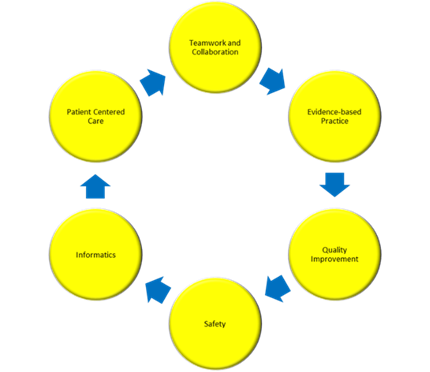
Quality and Safety Education in Nursing (QSEN) competencies which were developed to prepare future nurses to have the knowledge, skills, and attitudes necessary to continuously improve the quality and safety of healthcare are defined as:
- Patient-Centered Care: The recognition that the patient is the source of control and full partner in providing compassionate and coordinated care that is based on respect for the patient’s preferences, values, and needs. (QSEN, 2018).
- Teamwork and Collaboration: The ability to function effectively within nursing and inter-professional teams, fostering open communication, mutual respect, and shared decision-making to achieve quality patient care. (QSEN, 2018).
- Evidence-Based Practice: The integration of the best current evidence with clinical expertise and patient/family preferences and values for delivery of optimal health care. (QSEN, 2018).
- Quality Improvement: Use of data to monitor the outcomes of care processes and use improvement methods to design and test changes to continuously improve the quality and safety of health care systems. (QSEN, 2018).
- Safety: The minimization of risk of harm to patients and providers through both system effectiveness and individual performance. (QSEN, 2018).
- Informatics: The use of information and technology to communicate, manage knowledge, mitigate error, and support decision making. (QSEN, 2018).
Abraham Maslow’s Hierarchy of Needs represents a major concept on which the practical nursing curriculum is developed. The nursing process is the vehicle through which the nurse enhances the health of the individual within one’s environment. The nurse incorporates cognitive and psychomotor skills, scientific and social foundations, communication skills and health promotion concepts in providing safe nursing care though the life span. The 5 levels of Maslow’s Hierarchy of Needs are:
- Physiological Needs
- Safety and Security
- Love and Belonging
- Self Esteem
- Self-Actualization
References:
National League for Nursing. (2014). Outcomes and Competencies for Graduates of Practical/Vocations, Diploma, Associate Degree, Baccalaureate, Master’s, Practice Doctorate, and Research Doctorate Programs in Nursing. New York, NY: National League for Nursing.
Quality and Safety Education for Nurses (QSEN) Institute. (2018). QSEN
Competencies
Cooper, K. & Gosnell, K. (2019). Foundations and Adult Health Nursing. St. Louis, Missouri: Elsevier.
End of Program Student Learning Outcomes
KCTCS Practical Nursing End of Program Student Learning Outcomes
Upon completion of this program, the graduate can:
- Promote the human dignity, integrity, self-determination, and personal growth of patients,
oneself, and members of the health care team (human flourishing).
- Contribute to developing, implementing, and evaluating culturally competent, individualized plans of care focusing on services and activities that promote health and independence, maintain, or restore health, or support a peaceful death and advocate for access and quality of care for patients.
- Reinforce teaching/learning processes to facilitate the patients informed decision making to support and achieve positive outcomes that demonstrate respect for diverse patients.
- Provide a rationale for judgments used in the provision of safe, quality care and
for decisions that promote the health of patients within a family context (nursing
judgment).
- Utilize the nursing process and Maslow’s Hierarchy of Needs as a basis for clinical judgment to optimize outcomes of care for the patient, family, and community.
- Establish and maintain effective/therapeutic communication in collaboration with patients, families, significant others, and members of the health care team;
- Provide nursing care through effective organizational skills and appropriate delegation within the scope of practice.
- Assess how one’s personal strengths and values affect one’s identity as a nurse and
one’s contributions as a member of the health care team (professional identity).
- Use principles of advocacy, quality, and safety, and caring to assist in improving healthcare outcomes.
- Exhibit professional behaviors/practice as defined by the ethical, legal, and regulatory frameworks of nursing.
- Employ ethical and responsible use of technology to locate, use, and communicate information to improve the quality and safety of patient care and the life and employability of graduates.
- Question the basis for nursing actions, considering research, evidence, tradition,
and patient preferences (spirit of inquiry).
- Consider evidence-based literature/research for use in nursing practice.
- Recognize need for continuous learning within the nursing profession.
KY Graduate Profile 10 Essential Skills
- Communicate effectively: Graduates will develop their ability to communicate effectively by listening, weighing influencing factors, and responding accurately and professionally. They will learn to express their thoughts coherently in writing, orally, and in formal presentations.
- Think critically in order to solve problems and create new ideas and solutions: Graduates will develop their ability to think critically by evaluating assumptions and assessing information to make informed conclusions. They will also learn to think creatively by combining ideas in original ways or developing new ways of addressing issues.
- Apply quantitative reasoning skills to analyze and solve numerical problems: Graduates will hone their ability to provide solutions guided by data and choosing the best methodologies for arriving at informed conclusions.
- Interact effectively with people from diverse backgrounds: Graduates will reflect on their own cultural identities, appreciate cultural and intellectual differences, and effectively interact with people from diverse backgrounds. They will have multiple opportunities to collaborate, communicate and work respectfully with people with different perspectives, ideas and cultural beliefs.
- Adapt to changing circumstances while leading and supporting others: Graduates will have learned how to accept change and find effective ways to work and thrive in different settings. They will learn to motivate others in the pursuit of a common goal and to coach others in the pursuit of this goal.
- Perform professionally within their chosen field of study or occupation: Graduates will have learned the importance of adhering to the code of ethics in their chosen profession and acting with honesty and fairness. They will have many opportunities to prioritize their tasks, manage their time, take initiative, and demonstrate accountability and reliability.
- Engage in civic life to improve society: Graduate will, throughout their college careers, learn from opportunities to engage in political, social and other activities to address issues that benefit society.
- Collaborate and work in teams: Graduates will have had numerous opportunities to collaborate with colleagues, become effective team members, and manage conflict.
- Demonstrate evidence of applied and integrated learning: Graduates will be able to articulate and apply the theoretical content of their academic preparation with relevant knowledge and abilities essential to their chosen career.
- Use information for decision making: Graduates will be able to identify, evaluate, and responsibly use information needed for decision making.
Technical Standards
Nursing at the technical level involves the provision of direct care for individuals and is characterized by the application of verified knowledge in the skillful performance of nursing functions. All students should possess sufficient:
- visual acuity, such as is needed in preparation and administration of medications, and for the observation necessary for patient assessment and nursing care.
- auditory perception to receive verbal communication from patients and members of the health team and to assess health needs of people through the use of monitoring devices such as cardiac monitors, stethoscopes, IV infusion pumps, Dopplers, fire alarms, etc.
- gross and fine motor coordination to respond promptly and to implement the skills, including the manipulation of equipment required in meeting health needs.
- physical strength and endurance to be able to access patients as well as provide patient care for extended periods of time. This may include transporting patients and equipment within a facility, standing or being mobile for 8-12 or more hours, constant standing and walking, lifting up to 50 pounds.
- communication skills (speech, reading, writing) to interact with individuals and to communicate their needs promptly and effectively, as may be necessary in the individual’s interest; according to KAR 314.051 (1) (c) An applicant is able to understandably speak and write the English language and to read the English language with comprehension; and
- intellectual and emotional functions to plan and implement care for individuals.
Students who need special accommodation to meet these standards should contact the Nursing Program Administrator or the Assistant Nursing Program Administrator.
Curriculum
Below is the curriculum pathway established by the PN Curriculum Committee at KCTCS.
Pathway 3 is offered at Ashland Community and Technical College.
Diploma: Practical Nurse Pathway 3
45 – 53 Credit hours
Description:
The Practical Nursing program prepares individuals to practice within the legal scope of practical nursing under the supervision of a registered nurse, advanced practice registered nurse, physician assistant, licensed physician, or dentist. The use of the nursing process at the practical nursing level toward the maintenance of health and prevention of illness, the observation and nursing care of persons experiencing changes in their health processes, and the evaluation of health practices of patients are emphasized.
Classroom instruction in theory and basic nursing skills is provided by multiple delivery methods. Under the guidance of program faculty, students gain valuable experience in the care of all ages in a variety of health care settings and/or community agencies - hospitals, long-term care facilities, clinics and childcare centers. (Transportation to the community agencies is the responsibility of each student.)
Acceptance in the Practical Nursing program is based on a selective admission process.
Progression in the Practical Nursing program is contingent upon achievement of a grade of “C” or better in each course and maintenance of a 2.0 cumulative grade point average or better (on a 4.0 scale).
Note: The Kentucky Board of Nursing (KBN) may deny a nursing graduate admission to the NCLEX-PN Exam if an individual has been convicted of a misdemeanor or felony that involves acts that bear directly on the qualifications of the graduate to practice nursing.
Implementation: Spring 2023
| Course Prefix | Course Number | Course Title | Credit Hours |
|---|---|---|---|
|
General Education |
|||
| ENG | 101 | Writing I | 3 |
| BIO | 135 | Basic Anatomy and Physiology with Laboratory OR | 4 |
| BIO | 137 | Human Anatomy and Physiology I AND | (4) |
| BIO | 139 | Human Anatomy and Physiology II | (4) |
| General Education Subtotal: | 7-11 | ||
| Technical Courses | |||
| NAA | 100 | NAA | 0-3 |
| CPR | 100 | CPR | 0-1 |
| AHS | 115 | Medical Terminology OR | 3 |
| CLA | 131 | Medical Terminology from Greek and Latin | (3) |
| NPN | 106 | Fundamentals of Nursing Care | 6 |
| NPN | 107 | Nursing Pharmacology | 5 |
| NPN | 125 | Mental Health | 3 |
| NPN | 201 | Child Bearing Family | 3 |
| NPN | 203 | Med Surg Nursing I | 6 |
| NPN | 204 | Med Surg Nursing II | 6 |
| NPN | 210 | Clinical Practicum | 4 |
| NPN | 225 | Nursing Leadership and Management | 2 |
| Technical Course Subtotal: | 38-42 | ||
| Total Credits: | 45-53 |
Revised: May 2022
Course Syllabus
The following information will be provided to students in each course syllabus at the beginning of each semester:
- The course instructor with contact information
- Course description, including course components such as lecture, lab/clinical credits, contact hours, pre or co requisite courses, location, day and time, etc.
- Course Learning Outcomes/Competencies
- Course textbook and materials required
- Class grading policies, grade distribution, and grading scale
- Class policies
- ACTC General College Policies
The student will be asked to read the course syllabus in its entirety, ask the course instructor for clarification as needed, and sign a syllabus acknowledgment form.
Program Admission
Information, including prerequisite courses, admission requirements and selective admission points, can be found on the program website (see link below). Applicants to the program are encouraged to make an appointment with their academic advisor to ensure completion of prerequisite courses and to ensure understanding of the selective admissions process.
Practical Nursing Program Page
Program Readmission
Students who are unsuccessful in the Practical Nursing program may be readmitted according to the following (KCTCS Senate Rules- Readmission Requirements):
- To be considered for readmission by the Practical Nursing Admissions Committee, the applicant must submit a written request to the Practical Nursing Coordinator and include evidence of remedial study, additional preparation, or the resolution of factors contributing to the unsuccessful course completion.
- All applicants requesting readmission must meet all current admissions guidelines.
- A student may be readmitted to the Practical Nursing program one time if the student has furnished sufficient evidence of remedial study, additional preparation, or the resolution of factors contributing to unsuccessful course completion. The Practical Nursing Selection Committee may recommend readmission a second time.
- If more than three years has lapsed since initial enrollment in the first nursing course of any practical nursing program, an applicant must repeat all nursing courses unless the student has demonstrated current competency by passing exams equivalent to comprehensive course final examinations (both written exams and clinical skills) if available at the college to which the student is applying.
In addition, the following will apply:
- If a student is unsuccessful in the first semester or withdraws from first semester courses, the student must reapply to the program as a new applicant and be considered by the Practical Nursing Selection Committee in the same manner as other new applicants. If selected, the student must complete all first-semester practical nursing courses.
- If a student is unsuccessful in the second semester or withdraws from second-semester courses, the student must apply for readmission as stated in the first section of the readmission policy. The student must sit for the PN Fundamentals HESI Exam and achieve a score of 900 or greater to be eligible AND pass skills evaluation. If the student wishes to be readmitted in the first semester, the student must reapply to the program and be considered by the Practical Nursing Selection Committee in the same manner as other new applicants. If selected, the student will complete all first-semester practical nursing courses.
- If a student is unsuccessful in the third semester or withdraws from third-semester courses, the student must apply for readmission as stated in the first section of the readmission policy. The student must sit for the PN Medical/Surgical HESI Exam and achieve a score of 900 or greater to be eligible and pass skills evaluation. If the student wishes to readmit in the first semester, the student must reapply to the program and be considered by the Practical Nursing Selection Committee in the same manner as other new applicants. If selected, the student will complete all first-semester practical nursing courses.
Program Progression
To enter a nursing course, a student must complete all prerequisite courses with a grade of “C” or better and meet all program admission requirements. Courses that are required to be taken concurrently with a nursing course must be successfully completed in the semester or bi-term in which they are required for the student to remain in the program. A grade of “C” or higher is required to pass all nursing courses. Students receiving a grade below “C” in these courses will not be permitted to continue in the nursing program.
If a student receives a grade of D or lower in the course, the student is considered unsuccessful. If the student is unsuccessful in the clinical, lab, or simulation component of a nursing course, the student will be considered unsuccessful and issued a grade of “D.” If a student withdraws from a nursing course, they must withdraw from all concurrent nursing courses in that semester. Students wishing to re-enter a nursing program must meet all admission requirements and follow the readmission policy.
Program Completion
Students must successfully complete all general education and technical courses in the appropriate sequence listed in the approved nursing curriculum for successful completion of the nursing program and must meet all graduation requirements listed in the ACTC graduation packet. Students must complete a graduation application packet in the last semester of the nursing program. This packet must be obtained from the Admissions/Registrar’s office or website. The packet must be completed in its entirety for the student to receive the appropriate credential from the college. Students must successfully complete the integrated 120-hour practicum, which is required by the Kentucky Board of Nursing, and they must purchase and complete an NCLEX preparation course in the last semester of the program. Once the student has met these completion requirements, their name will be submitted to the state board of nursing certified list so that they may apply and test for a nursing license. Students are encouraged to participate in the college graduation ceremony and the program pinning ceremony upon completion of the program. If students choose to participate in these celebratory events, they are expected to comply with guidelines and rules for each.
IV. General Program Policies and Procedures
Students enrolled in the nursing program at ACTC are expected to follow the KCTCS Student Code of Conduct. Provided below is a link to the current code of conduct for review and reference as needed. Due to the specific nature of programs of nursing, students enrolled must follow additional policies and procedures to ensure program efficiency, to provide effective learning environments in a variety of settings, and to promote the safety of students, faculty, and patients. Following are specific policies and procedures students must adhere to in addition to the KCTCS Code of Conduct.
1. Academic Advising
The Nursing Program Administrator and the Assistant Nursing Program Administrator serve as the advisors for students enrolled in the Nursing Program. Students are strongly encouraged to make appointments to discuss academic matters and concerns as they arise. Students should not drop/add courses without the coordinator’s approval.
2. Attendance/Tardy/Extended Absence
Purpose
This policy serves to aid students in establishing workplace habits necessary for a successful career in the nursing profession and to promote academic success. Punctuality and attendance are required for all classes, labs, clinical, and simulation experiences. The faculty recognize that there may be unavoidable and emergency situations which may result in the student being absent or late. The following will apply when a student must be absent or tardy.
Definitions
Absence - failure to attend any scheduled class, lab, simulation, clinical, or other required
event planned for educational purposes in the nursing program.
Tardy - failure to arrive at the designated start time for any scheduled class, lab, simulation,
clinical, or other required event planned for educational purposes in the nursing
program.
Procedure
- Faculty will take attendance for each scheduled course event and document students who are absent or tardy. Students should NOT sign another student’s name to an attendance roster.
- Students should contact the course instructor and the health science administrative assistant when they anticipate being late or absent for a scheduled class, lab, clinical or other required educational event. Voice mail messages or email will be considered acceptable notification. Notification at least one hour prior to the beginning of the class, lab, clinical or event is required except in emergency situations. Failure to make proper notification of absence or tardiness will result in implementation of the Progressive Discipline Policy.
- All time missed from scheduled classes, labs, clinical, simulations or other required events, whether deemed to be excused or unexcused will be documented. All required open lab hours must be documented for each nursing course in their entirety prior to the date and time listed as the “last day to log lab hours” on the semester calendar.
- Students must provide supportive documentation related to any absence or tardy occurrence.
Documentation submitted by the student may be verified by contacting the
issuer. - Work and employment-related activities are not considered an excused absence.
- The following will be considered an excused absence:
- Illness: If an absence is caused by illness, a healthcare provider’s excuse is to be submitted upon return. Routine medical and dental exams and visits are not considered excused absences. Students are asked to schedule routine or follow-up office visits on their “off day” or before or after class, lab, simulation or clinical. Absences due to ill children require an excuse from the child’s provider. Missed time due to illness without a health provider excuse is considered unexcused.
- Emergency: If a student should be absent due to an emergency or death of a family member or significant other, the absence may be considered excused. The student is asked to provide supporting documentation if available.
- Religious Holidays: An excused absence may be granted for students to observe specific recognized religious holidays.
- Professional Leave: An excused absence may be granted for preapproved professional development.
- After the third occurrence of being tardy for a scheduled class, lab, or clinical or returning late from a scheduled break during one semester of nursing courses, the Progressive Discipline Policy will be implemented by the instructor.
- When a student has 3 absence occurrences during one semester of nursing courses, the student will be referred to the Nursing Program Administrator or the Assistant Nursing Program Administrator for an attendance conference. The attendance issue will be discussed, submitted supporting documentation will be reviewed, and an Attendance Improvement Plan will be established.
- One clinical experience per semester may be made up on the designated clinical make-up day if appropriate documentation of an excused absence is provided to the program coordinator. Examples of appropriate documentation includes a medical excuse, court appearance excuse, documented family emergency, or serious illness/death in the immediate family.
- A second missed clinical experience may result in an unsatisfactory grade for the clinical day. Exceptions to missed clinicals may be granted based on the extended absence policy. Nursing faculty will review documentation for the second missed clinical to determine if the clinical may be made up or if the student will receive an unsatisfactory “U” for the day. All clinical hours must be completed prior to issuing final grades in nursing courses.
- Additional absence(s) after an Attendance Improvement Plan has been established will be evaluated by the program faculty, the Nursing Program Administrator and the Assistant Nursing Program Administrator. Whether absences are excused or unexcused, the students’ current academic standing in each course will be considered. The faculty and program administrators, and as necessary, other college administrative staff, may recommend one of the following: revision of the Attendance Improvement Plan, withdraw from the program, implementation of the Progressive Discipline Policy, or dismissal from the program.
Extended Absence Policy Purpose
To be successful in a nursing program, excellent attendance and student engagement in learning activities is critical. Multiple absences, episodes of tardiness, and extended absences often lead to the student being unsuccessful. The ability to make up for extended absences, while keeping up with current course work can become very difficult to manage for students and faculty alike. For this reason, additional policies are required to ensure students and faculty are provided with a plan to follow when absences, tardiness, or extended absences may occur. The purpose of this policy is to provide faculty and students guidance when students are faced with situations requiring extended absence. Included in this policy are guidelines for how missed course work and lab/clinical hours due to an excused extended absence can be made up.
Definitions
Extended absence - any personal situation requiring the student to be absent for a period of 3 days to up to two weeks.
Excused extended absence - Examples of an excused extended absence would include (but are not limited to) the death of an immediate family member (spouse or significant other), surgery, serious illness requiring hospitalization, communicable diseases (such as Covid or Influenza) requiring medical attention and/or quarantine, providing care for an immediate family member, spouse, or significant other with a serious health issue, etc.
Procedure
- Students who must be absent for more than two weeks due to an extended illness must withdraw from all nursing program courses. The student would then follow the policy regarding program readmission. Special consideration for an extended absence lasting longer than two weeks must be reviewed and approved by the Nursing Program Administrator and the Assistant Nursing Program Administrator, all program faculty, and the appropriate college dean.
- A student may have only one extended absence per semester. Additional situations requiring the student to have more than once extended absence per academic semester must be reviewed and approved by the Nursing Program Administrator and the Assistant Nursing Program Administrator, all program faculty, and the appropriate college dean.
- Students must provide documentation for the extended absence to the program coordinator, and a medical release should be submitted before returning to school if applicable. Documentation submitted by the student may be verified by contacting the issuer.
- The student will be required to make up all missed lab and clinical hours. The student should contact the lab and clinical instructor for the course to develop a schedule of when those missed hours and assignments will be made up upon the student’s return. Any outstanding skills evaluations must be completed before participating in the course final skills evaluation.
- For missed lectures, the student must meet with the classroom instructor or course leader, to establish how missed lecture content will be obtained. The faculty will use their own discretion as to how missed information, handouts, slides, etc. will be provided to the student. The student should refer to the “class schedule” document, the semester calendar, and the course Blackboard shell for reading assignments, homework assignments, quizzes, etc. The instructor or course leader will prepare a schedule and due dates as to when assignments, quizzes, and exams are to be made up. ALL assignments, quizzes, and exams must be made up prior to sitting for the course final. If equipment is available and the student is able, faculty may allow students on excused extended absence to join class lectures using the Teams app. This option will only be available to students with an excused extended absence. This option will not apply for general absences and tardiness.
- Students absent for short periods of time (less than three) should follow the general attendance policy.
3. Progressive Discipline
Purpose
The progressive discipline policy's goal is to ensure fair and consistent treatment of all students and to promote an environment conducive to learning. The profession of nursing demands professionalism, teamwork and collaboration, and ethical and legal nursing practice. Following rules, regulations, policies and understanding consequences can result when those are not followed, will contribute to student success in this program and as a licensed professional nurse. This policy will serve as a means of communication between faculty and students and will provide appropriate documentation of incidents.
Procedure
- Each student will be given either an electronic copy or a hard copy of the ACTC Nursing Student Handbook and will be given the opportunity to review and ask any questions related to its contents. Once all questions have been answered to the student’s satisfaction, an acknowledgment form will be signed indicating the student understands the rules and guidelines contained within.
- The students will have access to the KCTCS Code of Conduct online via the ACTC website.
- Students are expected to follow all rules, guidelines and policies contained in these documents while on campus and while participating in learning activities and events held off-campus.
- This policy will be implemented while the student is enrolled in the program. Any documentation related to this policy will remain in the student’s record permanently and will be carried forward should the student require readmission to the program.
- Any documentation related to this policy contained in the student’s file may be reviewed by the ACTC Nursing Selection Committee when considering a student for readmission to the program.
- When a student violates a rule or policy (depending on the severity of the violation**)
progressive discipline will be implemented as follows:
- 1st Offense - The student will receive an email from the instructor witnessing, or receiving report of, the offense. Acknowledgment of receiving this email (via an email reply) will be required. The Chief Student Affairs Officer will be notified.
- 2nd Offense - The student will meet with the instructor and the Nursing Program Administrator and/or the Assistant Nursing Program Administrator regarding the offense. Documentation of the meeting, including instructor observation and student response, will be signed by both parties, and made part of the student’s file. The Chief Student Affairs Officer will be notified. Additional sanctions related to violations of the “student code of conduct” may occur.
- 3rd Offense - The student will meet with a panel of instructors (no less than three), including
the program coordinator, and provide documentation of reasons the student behavior
may have been justified. Faculty will decide if this constitutes reasonable defense
of the student behavior.
- If faculty vote that it does not, the student will be removed from the nursing program immediately.
- If faculty vote that the excuse justifies the behavior, the student will remain in the program with the stipulation that additional offenses may constitute removal from the program.
- The Chief Student Affairs Officer will be notified. Additional sanctions related to violations of the “student code of conduct” may occur.
**Serious violations or violations of certain rules or polices, can result in immediate dismissal from the program. Examples include causing physical or emotional harm to a client, fellow student, or faculty member, academic dishonesty, etc.
4. Grievances
Purpose
KCTCS, ACTC, and faculty in the nursing program strive to provide a safe, fair environment in which students can learn and are assessed fairly. If after attempting to remedy issues that may arise while in the nursing program, a student continues to feel they have been treated or evaluated unfairly, they are encouraged to file a formal grievance so that a formal resolution can be achieved.
Definition
Grievance - A formal complaint filed by a student after attempts for resolution of an issue have been unsuccessful and the student continues to believe their academic rights according to the KCTCS Student Rights policy have been violated or they have been treated or evaluated unfairly based on the KCTCS Student Rights policy.
Procedure
Students who have issues or concerns regarding nursing program policies and procedures, or feel that their student rights have been violated, should contact the nursing program administrator. Students who have questions related to the KCTCS Code of Conduct should contact the Chief Student Affairs Officer first. When a student believes they have been treated or evaluated unfairly they should do the following:
- Schedule a meeting with the appropriate instructor to discuss the issue or concern.
- If the meeting does not result in satisfactory resolution of the issue, schedule a
meeting with the Nursing Program Administrator and/or the Assistant Nursing
Program Administrator - If the student then feels resolution efforts are not satisfactory, schedule a meeting with the Associate Dean of Health Sciences.
- The Chief Academic Officer or the Chief Student Affairs Officer, if the issue remains unresolved, will then give the student instructions on filing a formal grievance with the college appeals board.
5. Emergency Response Plan
Emergency on Campus
If a student or nursing department employee has an emergency while on campus, the following should be implemented:
- Call 911 if appropriate (AED, first aid kits, and Stop the Bleed kits are available at the security desk on the 2nd floor of the main building at the College Drive Campus).
- Contact ACTC security.
- Obtain student or employee file to obtain emergency contact information and attempt to contact the person(s) listed. This information may be found in PeopleSoft or a hard copy file in the Nursing Department Records Room (#463D).
- Notify the Nursing Program Administrator and/or the Assistant Nursing Program Administrator of the incident.
- Complete and submit a KCTCS incident report and other required forms.
- Follow-up with student or employee and obtain medical release to return to school or work.
Emergency off-campus (at clinical site):
If a student or nursing department employee has an emergency while off campus, the following should be implemented:
- Call 911 if appropriate. If the incident occurs in the clinical setting, activate the emergency response system per facility protocol.
- Call 606-326-2000, ask to be connected to the Health Science Division Department Assistant or the Nursing Program Administrator or the Assistant Nursing Program Administrator. Request the student or employee’s emergency contact information and attempt to contact the person(s) listed. This information may be found in PeopleSoft or a hard copy file in the Nursing Department Records Room (463D).
- Ensure the Nursing Program Administrator and/or the Assistant Nursing Program Administrator are notified of the incident.
- Complete and submit a KCTCS incident report.
- Follow-up with student or employee and obtain medical release to return to school or work.
- Students and nursing department employees should update their emergency contact information
on file at ACTC annually and whenever their contact information should change. Students
and nursing department employees are encouraged to provide their immediate family
members or other members of their support system with the following numbers, in the
event the student or nursing department employee needs to be reached in an emergency.
- ACTC main operator: 606-326-2000
- Health Science Administrative Assistant- Jessica Slone 606-326-2086
- Nursing Program Administrator- Deena Howerton 606-326-2012
Assistant Nursing Program Administrator – Melissa Green 606-326-2087
Students are encouraged to have personal healthcare insurance, as they are responsible for their own expenses incurred because of illness or injury sustained during educational activities.
6. Confidentiality
Maintaining confidentiality of patient information acquired during clinical experiences is required of all students. Divulging such information could result in legal charges of slander or libel and is considered a break in the ethical and legal nature of nursing practice. Documented occurrences of failure to maintain confidentiality could result in unsatisfactory evaluation and dismissal from the nursing program. Students must maintain confidentiality of client information according to the Health Insurance Portability and Accountability Act (HIPAA). This includes all written, verbal, or any form of information contained on any type of electronic device. Cameras and recording devices are not permissible in the patient care areas. Students should NEVER post information, with or without patient names, on social media platforms.
7. Transportation
Students are responsible for their own transportation to classes and off-campus class or clinical experiences. Placement in specific clinical settings or lab groups based on transportation needs cannot be guaranteed. Students may request a lab or clinical group trade by having both parties submit a written request to the instructor. Again, accommodation for such requests cannot be guaranteed.
8. Chemical Impairment
When a nursing student reports for learning experiences (class, lab, simulation, or clinical) and is determined by the instructor to be unsafe to perform required responsibilities in those areas, the following protocol should be followed:
At the Time of the Occurrence
- The faculty member will make a written notation of the behavior and the
- physical appearance, such as-flushed face, red or bleary eyes, unsteady gait, slurred speech, diaphoresis, tremors and excessive restlessness;
- behavior changes such as- extreme and rapid mood swings, increased irritability with peers and others, loud, inappropriate talk, laughter or gestures, and dramatic change in personal grooming; and
- performance changes such as sleeping, the inability to focus on the topic at hand, etc.
- The faculty member should report the incident immediately to the Nursing Program Administrator and the Assistant Nursing Program Administrator.
- If it is determined that the student is unsafe, the faculty member should:
- Terminate the student's classroom, lab, simulation, or clinical assignment immediately. Contact the campus Behavioral Intervention Team (BIT).
- Inform the student that their inability to practice/learn safely requires that they be dismissed from the classroom, lab or clinical site immediately.
- Make arrangements for the student to be taken home by family, friends, or via public transportation if necessary. Utilize 911 emergency response system as necessary. Note name of person designated to drive student home.
- Notify facility or campus security and appropriate administrative staff of the incident and complete any required incident reports.
Follow-up
On return to campus the faculty member involved will:
- Complete an anecdotal record of the incident in detail. Discuss with the Nursing Program Administrator and/or the Assistant Nursing Program Administrator. All parties must maintain strict confidentiality.
- Schedule a conference including the student, instructor, and the Nursing Program Administrator and/or the Assistant Nursing Program Administrator, and the Chief Student Affairs Officer.
- Confront the student with the factual account of the incident. Share inference that the question of substance abuse is suspected.
- Allow student to express his/her account of the incident on a written anecdotal record form.
- Inform the student of faculty's desire to assist with the suspected substance abuse problem and provide the student with phone numbers and names for local help sources.
- Inform the student that KCTCS and the community college identify on-campus alcohol and drug use as punishable offenses, and that further instance of unsafe behaviors will be documented and may result in the student being unsuccessful in the enrolled course. Review the KCTCS Student Code of Conduct with the student.
9. Dress Code
Purpose
Students should consider that appropriate professional dress is considered for employment in healthcare settings. The student should desire to always present themselves appropriately and professionally in the classroom, lab, simulation, and clinical setting. Dress or appearance that interferes with the learning environment will not be permitted. Students are encouraged to practice good personal hygiene as well, as this is required when providing care for clients in the healthcare setting and will also promote wellness and aid in preventing some forms of illness and disease. All students must follow the following dress code:
Procedure
- A selected program uniform is to be purchased through the college bookstore. The ACTC Nursing program patch must be securely attached to lab coats and scrub tops on the upper left sleeve. These can also be purchased in the college bookstore.
- An ACTC student nurse ID badge, a stethoscope, and a pen light will be required for use in the skills lab and clinical setting.
- Uniforms must be clean and wrinkle-free. Uniforms should fit properly for functionality and professionalism.
- Shoes must be mostly white nursing shoes (can be athletic type) and must be kept clean. Open-toed, open-heeled or shoes with holes or mesh will not be permitted.
- Students’ hair must be kept clean and secured to prevent it falling forward during patient care. Head covers or headbands must be solid white or solid royal blue. Beards and/or mustaches must be neatly trimmed.
- Nails must be kept clean, and the length even with tips of the fingers. All types of nail polish and artificial nails are prohibited.
- Jewelry is limited to a flat surfaced wedding band, watch, and a single pair of small posts may be worn by those with pierced ears in the ear lobe. No other visible body jewelry (including tongue jewelry and other piercings) is permitted. Tattoos or body art will be required to be covered during clinical experiences. Coverings for tattoos and body art must be skin color, nude, or clear. Clothing (undershirts or sleeves) worn to cover tattoos or piercings (in addition to the program uniform) must be all white.
- Only natural hair colors (black, brown, blonde, natural red, natural gray) will be permitted in the clinical setting. The student must meet the dress code requirements of clinical facilities.
- Perfumes/aftershaves must not be used during clinical experiences, as they are harmful for clients who have allergies and other respiratory problems.
- Chewing gum is not allowed on the clinical units.
- Identification badges are required to be worn at the clinical agency for all clinical experiences. The badge must be worn in the lapel area with the picture always showing when you are in the assigned facility. This is the law in Kentucky.
- If the student is permitted to wear “business casual” dress to a clinical experience or when representing the ACTC Nursing Program, the student must wear the designated program lab coat. Business casual dress includes slacks, dress pants or skirts of appropriate length. Jeans or shorts are not permitted. T-shirts or halter tops are not permitted. Students must always wear their ACTC Nursing ID as well as agency badge (if the agency requires a specific badge to that facility).
- A lab coat and/or scrubs of any color and style are to be worn when logged in for skills lab. Shirts or tops exposing the abdomen are not permitted in the lab. Shorts, if worn, should be at the mid-thigh or longer.
- The full program uniform and following the dress code for clinical experiences are required for simulation and final skills evaluations.
10. Tobacco Use
Tobacco use of any kind is not permitted on ACTC campuses or at affiliated healthcare agencies. Students are not allowed any type of tobacco use during clinical experiences due to sensitivity of respiratory clients to the odor that lingers on hair and clothing. Students are prohibited from using other smoking devices (vape) and other tobacco containing materials (smokeless tobacco). Students who choose not to comply with the tobacco use policy will be dismissed from clinical and evaluated accordingly and the Progressive Discipline Policy will be followed.
11. Pinning Ceremony/Academic Achievement Ceremony
The pinning ceremony for graduates of an ACTC nursing program is a celebration of student accomplishment and a traditional initiation into the profession of nursing. The ceremony for graduates is hosted by nursing faculty and members of administration at ACTC. The Pinning Ceremony is modeled from the ceremony in the 1860’s when Florence Nightingale, the founder of modern nursing, was awarded the Red Cross of St. George in recognition for her service during the Crimean War. During the pinning ceremony faculty officially ‘pin’ students by placing a school pin on their lapel and offer words of congratulations for achieving the extraordinary accomplishment of completing the nursing program at ACTC. The pinning ceremony includes faculty and graduates reciting the Nightingale Pledge which serves as a means for the graduate and faculty to commit to providing care with compassion, high standards, and respect for the patient and the profession. A candle lighting takes place to commemorate Florence Nightingale, “the lady with the lamp,” and her commitment to the profession and the soldiers she served during the Crimean War. The candle lighting also symbolizes graduates carrying what they have learned from faculty during their time in the program into their own practice as future nurses.
An academic achievement ceremony is held to celebrate LPNs advancing their nursing education to ADN/RN at ACTC.
Guidelines for ACTC’s Nursing Pinning/Academic Achievement Ceremony
- The graduates must wear an all-white uniform and white shoes for the pinning ceremony. LPN to ADN graduates will wear an all-white lab jacket/coat and professional dress clothes. Wearing a nursing cap for pinning is optional and will be provided for those who wish to wear one. Graduates who arrive out of the required dress for the ceremony will not be permitted to participate.
- Graduates must purchase an ACTC program of nursing pin for the ceremony. The pin must be purchased through the school bookstore. Other pins purchased by the student will not be used during the ceremony.
- Nursing faculty from ACTC will plan, organize, and set up the ceremony and provide a ceremony program for guests and graduates.
- A member of the ACTC nursing faculty, voted by the graduating cohort, will pin all graduates during the ceremony.
- Students will attend a short practice session before the ceremony.
- A guest speaker for the ceremony will be voted for by the graduates. The guest speaker selected will be approved by the college administration.
- The class valedictorian (student with the highest GPA in nursing program and required general education courses) will be announced and may be invited to speak.
- Students in each cohort will nominate a graduate for the “ACTC Spirit of Nursing Award”. Nursing faculty will vote from nominations received and the winner of the award will be announced during the ceremony.
- A faculty member voted on by the class will lead the class in the Nightingale Pledge.
- The class chaplain will be invited to offer a benediction.
- A student representative speaker, selected by the class of graduates, will speak on behalf of the graduating class.
- An entrance and exit song will be selected by the class of graduates and approved by the college administration.
- Graduates are encouraged to bring a photo or personal item(s) to be placed on a memory table dedicated to family members or friends of graduates who have passed on, so that in this way they may be a part of this special ceremony.
- Guests will not be permitted on stage during the ceremony but are welcome to move forward to photograph graduates as they are pinned.
12. Recommendation for Employment
Students should expect to spend at least two hours of study per week for each hour spent in the classroom. Additionally, preparation is required for simulation and clinical learning experiences. A certain number of hours spent in the skills lab is required for most nursing courses, as well. A weekly schedule, which maps out class, lab, practice, and study time, can assist students in managing their time effectively. Incorporating outside work hours into such a time-intensive educational experience is not always easy. Students are encouraged to consider these factors when making employment decisions while enrolled in the nursing program.
The college is not responsible for students working in a health care agency unless
the students’ activities are part of a scheduled nursing course clinical experience.
Employment responsibilities are not considered acceptable excuses for a student’s
inability to meet any curricular requirements and are not considered an excused absence.
For patient and student safety, students are cautioned about arriving to learning experiences, particularly clinical, without adequate rest and sleep (for example, working midnight shift before a day-shift clinical). If a student is noted to have difficulty staying awake or appears overly fatigued, the nursing instructor may end their clinical or learning experience and assist in arranging safe transportation home. The student’s grade for the clinical day or learning experience may be impacted by the dismissal.
13. Academic Dishonesty/Plagiarism
The student is expected to adhere to the KCTCS Code of Student Conduct concerning academic honesty (see ACTC Student Policies and Procedures). Confirmed cheating and plagiarism will result in failure of a nursing course and thereby dismissal from the nursing program. Instructors trust that all students will be honest when writing examinations and/or other assignments. This includes, but is not limited to, wrongfully giving, taking, or presenting any information or material by a student with the intent of aiding another student with any academic work which is considered in the determination of the student’s grade. Anyone found violating this policy will automatically receive a grade of “E” for the course. PLAGIARISM (reproducing someone’s work, whether it be a published article, chapter of a book, a paper from a friend or some file) and CHEATING (wrongfully giving, taking, or presenting any information or material) will not be tolerated. Refer to the KCTCS CODE of STUDENT CONDUCT for a complete description of offenses and sanctions for academic offenses. The Nursing Program Administrator and/or the Assistant Nursing Program Administrator must be notified IMMEDIATELY when cheating or plagiarism is suspected or discovered so that an immediate, thorough investigation of the situation can be conducted. Students may choose to use AI (ChatGPT for example) for assignments. If they choose to do so, the use of AI, which product was used, and an explanation for how AI was utilized must be appropriately referenced with the student’s submitted work (see AI Use policy under VI).
14. Letters of Recommendation
Students desiring letters of recommendation from faculty must make their requests in writing. If a recommendation or reference is needed for employment, no information can be given to prospective employers over the phone. Please direct prospective employers to send the appropriate forms directly to faculty so your signed release can be seen prior to release of any information.
15. Cell Phone Policy
Students are permitted to bring personal cell phones to the classroom, skills lab, simulation lab, and clinical. Cell phones are ONLY to be used for emergency purposes while students are in these teaching/learning environments. If a student must use their cell phone (for an emergency call or text) while teaching/learning is taking place, they must step out of the classroom or lab to do so.
CELL PHONES ARE NEVER TO BE USED IN PATIENT CARE AREAS DURING CLINICAL AT CLINICAL SITES. THIS INCLUDES PATIENT ROOMS AND RESTROOMS, HALLWAYS, NURSES STATIONS, ETC. STUDENTS MUST GET PERMISSION FROM THEIR CLINICAL INSTRUCTOR TO USE THEIR CELL PHONE AT CLINICAL SO AN APPROPRIATE LOCATION CAN BE PROVIDED.
16. Children and Guests in Classrooms/Labs/Hallways
To provide a safe and effective teaching/learning environment for all, only students currently enrolled in the nursing course are permitted in the classroom, skills lab, simulation lab, or at the clinical site. ACTC faculty and scheduled guests may be permitted in these areas as well. Children, friends, family members, etc. of nursing students are not permitted in these areas while teaching/learning are taking place or after posted hours. If a student does not have childcare, they must notify the instructor of the reason for their absence. The student, with instructor guidance, is responsible for obtaining missed lecture content and teaching materials/handouts for the instruction missed. Per the KCTCS student code of conduct, students should not leave a minor unattended on campus.
17. Use of Technology
Students in the nursing program are required to use basic computer skills which include, but are not limited to, the following:
- Sending and receiving email using their KCTCS email address
- Accessing their student self-service account
- Use of the college learning management system, Blackboard
- Creating, accessing, printing, and saving electronic documents
- Use of Microsoft Office programs; primarily Microsoft Word and PowerPoint
- Use of program selected electronic resources such as the electronic medical record system, exam/testing product, and various electronic resources for learning
- Use of internet and search engines
The student will be provided with orientation, tutorials, and training for computer programs and resources used at the college and in nursing programs. The student should assume responsibility for access to a home computer and/or laptop or other portable device which support electronic products and programs selected by program faculty and reliable internet access as well. The student should ensure the appropriate settings for these programs are compatible and current on their device(s). The student should ensure access to a reliable printer as necessary. The student will have access to various electronic programs via “My Path” which are provided using their college username and password. Should the student have difficulty accessing or using the required technology to be successful in the program, they should contact their course instructor, the nursing program administrator, or the assistant nursing program administrator. Lack of access to computers or electronic programs and devices or poor or absent internet access will not be accepted as an appropriate excuse for late assignments, exams, papers, etc. The student may contact as_it@kctcs.edu with any issues related to their college accounts or email. The student is encouraged to use the college library, on-campus or online, for assignments, research, and class projects.
V. Student Records/Clinical Requirements
Upon being selected for the nursing program, students will be required to attend a mandatory new student orientation. During this orientation, students will be provided with a list of required documents to be submitted to attend clinical experiences. Students may be required to purchase (out of pocket fees) record keeping compliance programs (for example, My Clinical Exchange and/or CastleBranch). These accounts must remain active, and compliance must be maintained during each semester of the nursing program or the student will not be permitted to attend clinical. In compliance with contractual agreements between the nursing program and healthcare facilities providing sites for clinical experiences, students must maintain current records. These requirements and records include, but are not limited to, a current CPR certification, testing for tuberculosis, proof of purchase of liability insurance, background checks and drug screens, various vaccination records, titers, and other such forms. Student records will be kept confidential and only released to clinical facilities if the student signed the appropriate release form. Students failing to remain compliant with requirements related to student records throughout the program will not be permitted to attend clinical and will receive disciplinary action for missing compliance deadlines. The absence will be considered unexcused, and the student will receive a grade of “U” unsatisfactory for the clinical experience.
VI. Classroom/Lecture
Each nursing course consists of a lecture component, which takes place in the classroom setting or online. The faculty plan a variety of learning activities for each class to accommodate various learning styles. The student is expected to actively participate in classroom activities during each scheduled class. The student will be provided with a course syllabus, course schedule, and calendar during the first day of class for each course explaining how the student will be evaluated, expectations for the course, supplies required for the course, etc. Students will sign an acknowledgment form indicating that they have been given the syllabus and an opportunity to ask questions and that they understand the policies and guidelines included. To create a sense of consistency throughout the program, the following classroom guidelines have been established.
Evaluation
Evaluation of student performance includes both formative and summative approaches. The student must achieve a grade of 78% or higher to pass the lecture portion of the course. The student must also pass the lab and clinical components to pass the course. Proctored examinations will be given and will include multiple choice questions, as well as other test item formats. The instructor will determine the number of exams that are to be given throughout the course.
Assignments will be given throughout the course and may include discussion board posts on blackboard, written assignments, group presentations, case studies, completing workbook assignments, etc. Students must submit completed assignments by the date and time designated by the instructor to receive full credit for the assignment. All assignments are considered course requirements and must be submitted before the final exam for the course. If required assignments are not submitted the student will receive a failing grade for the course (E). The minimum cumulative passing score required to pass a course is 78%.
Grading Scale
The grading scale for the practical nursing program is as follows:
- 92 - 100 = A
- 84 - 91 = B
- 78 - 83 = C
- 69 - 77 = D
- 0 - 68 = E
A grade of C or higher AND passing skills lab, clinical, and simulation are required for passing a course.
Grades in the course will not be rounded up, including the overall final course grade. For example, this means a 77.99 is not considered passing and grade of 83.99 is considered a C, etc.
Exam Preparation Activities (EPAs) and other assignments will be given throughout the course and may include group work, presentations, discussion boards, written work, case studies, drawings, etc. The course instructor will determine the number of points, if any, these learning activities will be worth. These activities will be designed to help the student learn or review content from each unit of instruction and to help them achieve success on unit and final exams.
Late Assignments
Nursing faculty create course assignments to enhance student learning. Assignments may or may not be allotted points in the course. Some assignments are considered “course requirements” (must be submitted to pass the course) and some may be graded as pass/fail. Assignments must be completed by the designated due date and time. Assignments with points allotted that are submitted late will result in a grade reduction but the work may still be required to be submitted prior to the last day of course work for the semester. Work uploaded to Blackboard or emailed to an instructor that includes written work or attached documents or links that are not viewable by the instructor will not be accepted and will be considered late and result in a deduction of points. Students are encouraged to submit work prior to the given deadline to allow time for the student to ensure documents, links and written work submitted are viewable. Please use the Blackboard Learn Help for Students feature as needed to learn how to submit work successfully. Faculty will consider documentation submitted by the student related to reasons for missed assignments in emergency or unusual situations. Faculty will determine if the late work will be accepted and how the work may be graded. Students approved for an extended absence should refer to the extended absence policy regarding assignments due dates and times.
Test Review
Immediately following computerized unit exams/quizzes, students are given time to review missed items.
- Students will be provided with a test review form to complete after they finish their exam.
- Prior to exiting the testing area, the student must show the exam proctor the test review form, in addition to any other scrap paper utilized during the exam.
- Faculty will complete a detailed item analysis following each exam and adjust test items as deemed necessary based on the item analysis. Students will be made aware of which items were adjusted and the rationale for the adjustment.
- The student will have 48 business hours after completion of the exam to submit a written request for a test item review. The request should include the rationale for the request and text pages related to the specific test item in question.
- The faculty will review the request, discuss, and decide if the item requires adjustment. The student will be notified of the determination.
- Exam grades will be returned to the student no later than one week after exam completion (except in institutional closings or faculty emergency). Students will have access to their exam scores once posted in Blackboard and may contact the instructor with questions concerning exam grades.
- Once exam grades are posted in Blackboard, the grades are considered final. Faculty will not make further adjustments to exam items or exam scores once the exam grade is posted in Blackboard.
Exam Remediation Policy
Remediation definition – The process by which a student improves or corrects a knowledge deficit.
Purpose: The remediation process is designed to promote success of students achieving learning outcomes.
Process: Following each exam, students will be provided an opportunity for remediation.
- Immediately following an exam, students who miss one or more items will briefly summarize the item missed on the approved test review form provided by the exam proctor.
- Students will then research items missed using the appropriate textbook(s)/resources for the course.
- To complete the remediation process, students will upload a picture of their test review form(s) in the appropriate section of the course shell in Blackboard. Then, students will submit their research on each missed item. Work might include writing a short paragraph, drawing a picture, or making a table, etc. to show understanding of the missed item.
- Each item missed must be referenced with a page number from a program textbook/resource identifying where the information was found. Internet references will not be accepted.
- Students will upload remediation assignments to the appropriate Blackboard course shell by the due date and time provided by the course instructor to receive points for the remediation assignment.
- Students who misplace their test review form(s) will be given an alternate remediation assignment. The alternate remediation assignment is due by the date provided by the instructor.
- Students neglecting to upload all remediation assignments prior to the final exam by the given due date and time will not be permitted to sit for the final exam.
- A student who does not complete remediation prior to the final exam will be given the opportunity to upload remediation on a later date designated by the course instructor. The student will then be permitted to take an alternate format make-up final exam.
- A student who does not submit remediation assignments by the due date prior to the alternate format makeup final exam will not be permitted to sit for that exam and will receive a grade of zero for the course final.
Standardized Exams
Some courses in the nursing program use standardized exams to assess student learning and to provide opportunities for remediation. Standardized exams are not written by nursing faculty at ACTC and are typically used for practice and remediation purposes only. A student’s score on standardized exams MAY be included in the points distribution for the course but will only be worth the same number of points as the exam in the course worth the lowest number of points. Students will be required to take standardized exams and complete the remediation assignment following the exam by the given due date and time to receive points. This assignment, like other remediation assignments, must be submitted prior to sitting for the final exam for the course.
Late or Missed Exams/Quizzes
If a student must be absent on the day of a proctored exam or quiz, the student must notify the instructor and the Nursing Program Administrator and/or the Assistant Nursing Program Administrator (see contact information) at least 24 hours prior (except in emergency situations). Students are not permitted to enter the testing area once an in-person exam/quiz has started. If a student is late or absent for an exam/quiz, the student must submit a request to the course instructor to sit for the make-up exam/quiz. Students who are late or absent must submit documentation of an acceptable excuse (See Attendance/Tardy Policy) with their request to take the make-up exam/quiz. Students who are late or absent and do NOT have acceptable excuse documentation must explain their tardiness or absence with their request to take the make-up. Nursing faculty will vote to determine if the student should be permitted to take the make-up exam/quiz. If the majority of nursing faculty vote that the student is not permitted to sit for the make-up, the student will receive a grade of zero for that exam. There are two (2) scheduled exam make-up days per semester. All missed exams and quizzes must be made up on the scheduled make-up days. All missed exams must be made up before the final exam date for the course. The student will not sit for the course final exam until all unit exams are completed.
Make-up exams and quizzes will be written and administered using an alternate assessment format and varied points distribution.
Rules for the Classroom
Students are expected to abide by the following rules in the classroom/online setting. Violating the KCTCS Code of Conduct or any of the following rules can result in disciplinary action (See Progressive Discipline Policy).
- Students are expected to follow the Student Code of Conduct as established by KCTCS and ACTC.
- Classroom attendance is required. It is the student’s responsibility to sign the attendance
roster each day and each time the roster is circulated in the classroom by the instructor.
Students should NOT sign another student’s name to the attendance roster. - Students are expected to actively participate in classroom learning activities and are encouraged to ask questions and/or make comments to enhance learning.
- Students are permitted to have cell phones in the classroom, but they must be silenced and used only for educational activities. In an emergency, the student is asked to step out of the classroom to take urgent calls or text messages. Casual use of the cell phone for texting, social media, etc. will not be permitted. If a student’s cell phone is heard during an exam/quiz, the student will be asked to leave the testing area and will meet with the nursing program administrator and/or the assistant nursing program administrator to discuss the incident and how, or if, the exam will be made-up. Cameras and recording devices are not to be used in the classroom without the instructor's permission.
- The student must arrive to class and exams on time. Once the instructor begins the class or the exam, the door may be locked, and late students will not be permitted to enter. If the student is going to be late, he/she must notify the instructor AND the nursing program administrator and/or the assistant nursing program administrator. The students can enter the classroom after the next break. Students who are late for exams will not be permitted to enter the testing area (see the Late or Missed Exams/Quizzes Policy). Students are expected to arrive at class prepared. This includes having completed any pre-class assignments and having all materials needed for the day (e.g. textbooks, note-taking items, electronic devices, etc.).
- During exams, all personal items are placed in a designated classroom area.
- Any form of academic dishonesty (cheating and/or plagiarism) will not be tolerated. (See KCTCS Code of Conduct).
- Students are expected to return from breaks on time. The classroom door may be locked once class resumes, and the student will not be permitted to enter the classroom until after the next break.
- Behaviors that are considered disruptive to the learning environment will not be tolerated. This includes, but is not limited to personal discussions with other students during lecture, dominating class time with multiple comments or questions, using cell phones for non-educational purposes, sleeping during class, exhibiting disrespectful or harassing behaviors towards other students or the instructor, refusing to participate in classroom learning activities, misuse of classroom materials and/or equipment, being under the influence, etc. If these or other disruptive behaviors are noted, the student will be asked to leave the classroom and will receive the appropriate disciplinary action. (See Progressive Discipline Policy).
- Students are expected to return materials and equipment belonging to the nursing department at the end of class and dispose of any trash in the appropriate containers provided.
- Rules for Computer Lab/Testing Rooms
- Arrive a few minutes early for the exam. If late, you will be required to take a make-up exam if sufficient documentation is submitted. Doors will be locked at the start of the exam.
- Place all belongings, cell phones, smart watches, books, and/or bag at the front of the classroom. Leaving all personal belongings in your vehicle and only bringing something to write with is preferred. No food or drink permitted in the testing lab.
- Log into the computer and the test. Be sure you are using the correct browser and are testing under your name.
- Place your name on both the scratch paper and remediation sheet. Nothing else should be written on these papers until after the proctor begins the exam.
- Only scratch paper and remediation sheets provided by the instructor may be used.
- Only the calculator provided in the exam may be used.
- Raise your hand if you have computer problems during the exam. Questions about the exam cannot be answered during the test.
- No talking once the exam has started.
- Do not move dividers or screen covers in the computer lab.
- Do not start the exam until instructed to do so.
- If you must leave the room during the exam for an emergency, notify the instructor.
- When finished, submit the exam, review missed items, upload (ensure the upload is complete), then log out of the test and log out of the computer.
- An instructor must review your remediation sheet and sign it before leaving the testing room quietly.
- Do not re-enter the testing lab after exiting. Do not ask questions or voice concerns about the exam when exiting the computer lab. Please email your instructor or request to meet with them at another time so as not to disrupt testing.
- AI Policy: Academic work submitted with outside resources and presented as original content is a form of Academic Dishonesty (cheating). Content generated by an Artificial Intelligence service or site (e.g. ChatGPT) without proper attribution or authorization is a form of plagiarism. Plagiarism is a matter of academic integrity. This includes, but is not limited to, (1) all forms of plagiarism, such as copying or paraphrasing work from other sources without using proper citation; (2) turning in someone else’s paper, a tutor’s work, or previously submitted personal work (prior semesters or courses); (3) submitting work generated through the utilization of technological tools, such as AI Content Generators (e.g. ChatGPT) or applications (e.g. apps such as Mathway), without acknowledgment and/or citation of their use.
Cheating in any form violates KCTCS and ACTC Academic Integrity policies and offenders will be subject to Article IV Sanctions for Standards of Conduct Violations of the KCTCS Code of Student Conduct. All work submitted should be a product of critical thinking and ideas, and written in your own voice, with all sources clearly acknowledged and cited, including technology-based sources.
VII. Clinical
Clinical experiences will be offered to the student under the supervision of a clinical instructor so that the student may learn to care for clients of various ages with a variety of health needs, in a variety of care settings. Students will utilize the human caring phenomena, the nursing process and safety in caring for clients while applying the knowledge and skills learned in the classroom and skills lab. Students must prove competence in performing skills for each course before performing those skills in the clinical setting with the instructor. Clinical objectives are created by the course instructor for each clinical experience to help the student meet course objectives.
Evaluation
Evaluation of clinical performance will be based on the student’s ability to meet the clinical objectives, demonstrate professionalism, and plan and provide safe, competent, patient-centered care.
- The student and the course instructor will receive regular feedback from their clinical instructor and a summative clinical evaluation will be completed by the course instructor at the completion of the course.
- The student must score 78% or higher on established criteria for their clinical and performance each week in the first semester, 80% in the second semester, and a B on the final practicum experience in the third semester to be considered satisfactory in the clinical component of the nursing course.
- If the student scores below the required score, their performance will be considered unsatisfactory (U).
- If the student receives unsatisfactory (U) twice during clinical for a course, they will fail the clinical component of the course and thus, the course. This includes a U for an unexcused absence, failure to meet clinical record requirements, violation of a clinical rule, or scoring below the passing standard on a clinical feedback rubric.
- Students should review instructor feedback and make improvements accordingly. The student is encouraged to meet with the clinical/and or course instructor if they are having difficulty in clinical or if they have unsatisfactory clinical performance.
- Violation of clinical rules (see below) can result in an automatic “U” for a clinical performance.
- Some nursing courses offer special clinical rotations which do not meet regularly each week during the semester. The student’s performance at these special rotations must be satisfactory and REQUIRED assignments must be submitted by the due date and time given by the course instructor. The course instructor will create a rubric to determine if the student’s written work and performance for the rotation was satisfactory or unsatisfactory. If the student does not submit the required work by the last date to submit course work or if their performance during the clinical rotation is unsatisfactory, the student will fail the clinical component of the course and thus, the course.
- A summative clinical evaluation will be provided for regular clinical experiences during the last week of clinical in the course summarizing the students’ overall performance. A grade of 78% or higher on the summative clinical evaluation is required for passing clinical in the first semester, 80% or higher in the second semester, and a B on the practicum evaluation in the third semester. Failure to obtain the required score on the final clinical evaluation will result in the student failing the course. The course instructor, with input from the clinical instructor, will make the final determination of the student passing or failing the course's clinical component.
Rules for Clinical
Because of the nature of providing care to clients in the clinical setting, students are expected to adhere to a variety of policies, procedures, rules, and guidelines set forth by the nursing program, KCTCS, the KY Board of Nursing and the facilities in which clinical experiences take place.
Violating the KCTCS Code of Conduct, regulations set forth by the KY Board of Nursing and the Nurse Practice Act, clinical site facility policy, or any of the following rules can result in disciplinary action (See Progressive Discipline Policy), as well as the student receiving a “U” for that clinical experience. If the violation is severe, the student will be dismissed from the program.
- Students are expected to follow the Student Code of Conduct as established by KCTCS and ACTC.
- In compliance with contractual agreements with healthcare facilities providing sites for clinical experiences, students must consent to a criminal background check and drug screen. The fees for both are the student's responsibility, and students will be informed during new student orientation of the manner in the background check and drug screens should be obtained. Results will be made available to the nursing program administrator, the assistant nursing program administrator, and the clinical coordinator and will remain confidential. If findings on the background check or a positive drug screen are discovered, the findings (without including the student’s name) will be reviewed by ACTC administration, a representative of the healthcare facilities where the student may attend clinical while in the nursing program, and/or the legal department at ACTC, so that approval may be given before the student is permitted to attend clinical. If the student is denied the opportunity to attend clinical based on their background check or drug screen results, the program of nursing is not required to create an alternative clinical experience. If the student cannot complete the clinical component of the course due to the inability to be placed at a clinical site because of the results of the background check or drug screen, the student will be permitted to withdraw from nursing courses.
- Clinical assignments are created by the nursing program administrator, the assistant nursing program administrator, clinical coordinator, and the course instructor. Consideration of students’ personal schedules and needs cannot be considered when making clinical group and rotation assignments as it is impossible to make those accommodations for all students. Students may be offered the opportunity to trade assignments with other students IF approved by the clinical coordinator, course instructor, the nursing program administrator, or the assistant nursing program administrator.
- Attendance in clinical is required by all students (See Attendance/Tardy policy). The student is responsible for signing the attendance roster each day. Students should NOT sign another student’s name to an attendance roster.
- CELL PHONES ARE NOT PERMITTED IN PATIENT CARE AREAS. If the student brings a cell phone to clinical, it must be silenced and kept in the break or conference room area. Students are not to have their cell phones on their person in patient care areas. If used for emergency or educational purposes in the break or conference room area, the student must ask for permission from the clinical instructor.
- A STUDENT MAY BE IMMEDIATELY DISMISSED FROM THE PROGRAM BY PLACING EITHER THE PHYSICAL OR PSYCHOLOGICAL HEALTH OF THE CLIENT IN JEOPARDY.
- The student is required to always adhere to the program and/or facility dress code (See Dress Code). ACTC Nursing ID and agency ID badges, if provided, must be always worn while in the clinical facility.
- Students are not permitted to smoke, vape, or use other tobacco products during clinical experiences due to the sensitivity of respiratory clients. Smoking during clinical can be considered putting the client in physical jeopardy.
- All required immunization records, TB skin testing or CXR results, a current healthcare provider CPR card, active liability insurance and a current background check and drug screen must be maintained on file before the student will be permitted to attend clinical. IT IS THE RESPONSIBILITY OF THE STUDENT TO ENSURE THESE RECORDS ARE CURRENT AND ON FILE (see section V).
- Some facilities may require a fee for clinical experiences. Failure to pay the fee by the due date, and failure to submit records by the due date will prohibit the student from attending the clinical experience. The student will receive a “U” for the clinical day. (See Section V).
- The student must arrive at the clinical site on time. If the student is to be tardy, the student must notify the clinical instructor AND the program coordinator at least one hour prior to the start of the clinical experience (except in the case of an emergency). Students who are late for clinical may be asked to leave the clinical site and will be required to make up any lost clinical time.
- The nursing program reserves the right to dismiss a student whose clinical performance for any nursing course is deemed unsafe as characterized by dangerous, inappropriate, irresponsible, or unethical behavior that actually or potentially places the student, a fellow student, faculty member, client, client’s family members or health team members in jeopardy.
- In addition to complying with program guidelines, the student must practice within the parameters of the KY Nurse Practice Act and comply with the policies and procedures of the health care agencies.
- Students must arrive prepared for the clinical day. Students must bring required materials which may include forms, textbooks, note pads, pen, equipment for assessments, etc. and must have completed all pre-clinical assignments. The instructor will advise the student of which assignments must be completed and what equipment and/or materials he/she should bring to the clinical setting.
- Failure to accept a clinical assignment or refusal to care for an assigned client without reasonable justification will not be tolerated and may result in the student’s performance being considered unsatisfactory.
- Acts of omission or commission in the care of clients such physical abuse, mental/emotional abuse, medication errors or placing the client in a hazardous position, condition, or circumstance can result in dismissal from the program. Students must IMMEDIATELY report any unusual incident such as these to their clinical instructor and appropriate facility personnel. The nursing program administrator and/or the assistant nursing program administrator must be notified immediately as well. All required documentation related to the incident must be completed correctly and in a timely manner.
- Disruption of client care or unit function related to poor interpersonal relationships with agency health team members, peers or faculty will not be tolerated.
- Any behavior that violates professional qualities such as a violation of client confidentiality or solicitation of client services leading to personal gain will not be tolerated.
- Students must comply with the chemical impairment policy.
- Students must comply with privacy and confidentiality policies and laws including the Health Information Portability and Accountability Act (HIPAA). This includes never copying client records or writing the client’s name on any clinical paperwork, discussing client related issues in public areas, or disclosing client information via social media outlets. It is recommended that students do NOT discuss issues related to clinical experiences on social media, even if the client or healthcare team member’s name is not included.
- Students who are unable to complete nursing skills safely and successfully in the clinical setting under the supervision of the clinical instructor will be referred to the course instructor for remediation in the skills lab and re-evaluation. The student must perform a successful in-person skills evaluation prior to performing the skill again in the clinical setting. The course instructor will communicate with the clinical instructor once the student has demonstrated competency with the skill.
- The student may only perform certain nursing skills in the presence of a clinical instructor or with another licensed nurse when delegated by the clinical instructor. However, the student is liable and responsible for their own practice and performance of skills in the clinical setting. The student is responsible for informing their clinical instructor of which skills they have successfully passed in skills lab before performing the skill in clinical.
- Students violating any of the above rules related to clinical, or those who violate the student Code of Conduct or agency policies/ procedures, or laws will be receive disciplinary action (See Progressive Discipline Policy) and/or asked to leave the clinical setting and depending on the severity of the violation, dismissed from the program. If facility staff dismisses a student from attending clinical due to inappropriate behavior or violation of a facility rule or policy, that student will not be permitted to complete the clinical component of the course, and therefore fail the course.
VIII. Skills Laboratory
Purpose
To offer our students flexibility and to encourage effective time management skills, responsibility, and accountability, the ACTC nursing department offers an open lab/self scheduling concept. Most nursing courses in the curriculum include a laboratory component. The skills lab provides instruction and resources which help the student master various nursing skills related to the course and the course objectives. The skills lab component of the course provides instructional videos and reading material for each skill, a resource library, medical supplies, and equipment, as well as practice mannequins. Instructor-guided practice is provided. Following instruction and practice, students are then evaluated on their ability to perform each skill independently and safely. Once the student passes a skills evaluation, they may then perform the skill in the clinical setting with their clinical instructor. To protect clients from harm and in accordance with appropriate nursing delegation, the student may NOT perform skills in the clinical setting until they have learned the skill and proven competency in their ability to perform the skill safely in the skills lab. The student may only perform certain skills in the presence of a clinical instructor or with another licensed nurse when delegated by the clinical instructor. However, the student is liable and responsible for their own practice and performance of skills in the clinical setting. The course instructor and the student are responsible for informing the clinical instructor of which skills have been successfully passed in skills lab before performing the skill in clinical.
Depending on the type of skill the student is learning, instruction and evaluation may be completed using alternative methods. The course instructor(s) will inform students how skill instruction and evaluation will be completed in the course.
At the end of the course, after the student has successfully performed each skill, the student will participate in a final skills evaluation. This evaluation will consist of an in-person skills checkoff of a randomly selected skill (or skills) from the list of skills taught in the course. The student is expected to correctly perform skills learned previously in the program during final skills evaluations. Participating in final skills evaluation is a program requirement and the student must pass the evaluation to be considered successful in the course.
Procedure
- Students will be advised of the number of skills lab hours they must log for each course and a calendar will be provided online, as well as posted in the skills lab, informing students of when skills labs will be open or closed. This calendar is subject to change but will only be modified in emergency situations, and students will be notified as soon as possible. In the event of institutional closing, online/virtual option for logging lab time may be offered based on the length of time the college may be closed. If the student does not log the number of required skills lab hours by the designated date and time at the end of the course, the student will be considered unsuccessful in the lab component of the course, and thus the course.
- Upon arriving at the skills lab, the student must clock in and sign in. TIME SPENT IN THE SKILLS LAB WILL ONLY BE COUNTED IF THE STUDENT LOGS IN BEFORE WORKING IN THE LAB AND LOGS OUT WHEN LEAVING. If the student forgets to log in or out, that time will NOT be counted in their total logged lab hours for the course.
- After logging in, the student must check in with the lab instructor on duty to report which skill(s) they will be working on.
- Students must wear their ACTC nursing ID badge when in the skills lab. If the student does not have their ID, they will not be permitted to work in the lab.
- Students must be signed in to work in the lab for one specific course at a time. If students wish to log time for more than one course, they must log out of one course and log into another course. The student must log out of the skills lab if they wish to take a lunch break. Only restroom breaks are permitted without logging out of the lab.
- The following may be counted in students’ logged lab time:
- Viewing instructional videos, reading lab assignments, or practicing med math at designated spaces in the skills lab only. Doing this work outside of the skills lab will NOT count as logged lab hours.
- Practicing skills in the skills labs. Practice outside of the skills lab will NOT count as logged lab hours.
- Faculty will designate a certain number of lab hours for final skills evaluations.
- Two hours will be deducted from the students’ required lab time for shooting each skills video in the course. Therefore, recording skills videos during lab time is NOT counted in the students logged lab time.
- The course instructor(s) will plan and oversee instruction and evaluation of skills for the course. The course instructor(s) will provide and communicate with the lab coordinator/instructors regarding the reading assignments, demonstration videos, skills sheets (containing critical criteria for each skill), and the evaluation tool that will be used to help guide the student to successfully meet the course objectives. These will be available to the student in the lab module of the Blackboard course shell.
- The student is responsible for reading and viewing all instructional materials provided prior to practicing the skill and as often as needed. The student is responsible for practicing each skill until they feel they have mastered the skill. The student should consult with the course instructor(s) and/or lab instructors when they feel they need clarification or assistance. Once the student feels they have mastered the skill, they should then attempt to record their performance video or prepare for evaluation.
- Students are expected to follow the Student Code of Conduct as established by KCTCS and ACTC.
- Only nursing students, faculty and staff are allowed in the skills labs.
- Students must purchase a lab kit and other required lab resources from the campus bookstore. The student should bring instructional materials and items for the skill they are practicing from their kit to the skills lab and scheduled skills evaluations.
- Falsifying, or attempting to falsify, skills lab hours is considered academic dishonesty and may result in dismissal from the nursing program.
- Use of personal devices (lap tops, tablets, cell phones, etc.) are not permitted in the skills lab. Computers and lap tops are provided and available for use in the skills lab. In an emergency, the student is asked to step out of the lab to take any urgent calls or text messages on their cell phone. Casual use of the cell phone or other devices for texting, social media, completing other course work or assignments, etc. will not be permitted.
- Behaviors that are considered disruptive to the learning environment will not be tolerated. This includes, but is not limited to, loafing, or socializing in the skills lab, creating excessive noise in the lab, using cellphones for non-educational purposes, sleeping, exhibiting disrespectful or harassing behaviors towards other students or skills lab instructors and staff, refusing to participate in skills lab activities, misuse of lab materials and/or equipment, being under the influence, eating in the skills lab, etc. If these behaviors are noted, the student will be asked to leave the lab and will receive appropriate disciplinary action (See Progressive Discipline Policy).
- Students are expected to actively participate in skills lab learning activities and use lab time to learn and practice skills. Students are expected to exhibit professional collaboration and teamwork with fellow students and skills lab instructors and staff when working in the skills lab.
- Students are expected to return materials and equipment belonging to the nursing department and dispose of any trash in the appropriate containers provided. Sharps and any hazardous materials must be properly handled and disposed of.
- Eating and/or drinking, except for a water bottle with a lid, is prohibited in the skills lab.
- Hair style, jewelry and clothing must not interfere with the safe and sanitary performance of nursing skills. A professional nursing appearance is expected in the skills lab (see Dress Code Policy).
- Open-toed, open-heeled or shoes with holes will not be worn in the skills lab.
- A lab coat or scrubs (scrub pants and a t-shirt are permitted) and the ACTC nursing student ID are required when attending skills lab.
- Students will be assigned skills to perform in recorded videos for evaluation of competency. Students will be informed of the skills they must perform in a video and the designated due date and time. Instructions will be provided regarding how and where a link to their video performance and documentation should be submitted.
The following guidelines are to be followed by the student when filming skills performance videos:
- The student will select a quiet area to film skills videos. Time spent recording videos should NOT be logged. Two hours has already been accounted for with each skills video to be submitted.
- No audiovisual prompts such as books, papers, posters, etc. are permitted in the filming area and no one is permitted to prompt or speak to the student while the skills performance is recorded.
- The student must record their skill from beginning to end without stopping or restarting
the camera. If this is noted or suspected the student will be referred and asked to
perform the skill in person and may receive progressive discipline if deemed necessary
by faculty.
(See Progressive Discipline Policy). - The student may record multiple times until they are satisfied with their performance/video. If the student makes mistakes while shooting the skills video, the student should start the recording over.
- ONLY ONE video of the skill will be accepted for evaluation. STUDENTS SHOULD VIEW
THEIR OWN VIDEO WHILE FOLLOWING THE SKILL CHECK SHEET
WITH CRITICAL CRITERIA HIGHLIGHTED TO ENSURE THEY PERFORMED THE SKILL CORRECTLY AND THAT THE VIDEO IS VIEWABLE. Unviewable videos or errors in performance cannot be corrected once the video is submitted for evaluation. - The student must submit appropriate nursing documentation with each skill. Videos submitted without documentation will result in the student being referred for remediation related to proper documentation of nursing skills.
- While performing the skill, practice mannequins (or other equipment) and/or volunteers are considered the patient, and all procedures should be performed as if they are being performed on a live patient. Therapeutic communication should be observed.
- The student and other video participants MUST exhibit professional behavior throughout the video. If this rule is not followed the video will not be accepted for evaluation and the student will be referred. Examples of unprofessional behavior may include laughing or making inappropriate comments during a video, being dressed inappropriately, etc. Only people involved in the skill being performed should be seen in the video. Pets should not be used or viewed in submitted skills videos.
- When recording videos for evaluation, students MUST wear a set of neat, clean, and wrinkle-free healthcare scrubs OR their school nursing uniform. Videos in which the student is wearing street clothes or is inappropriately dressed will not be accepted and the student will be referred. Hair must be off the collar, and the student’s attire should not interfere with the safe and sanitary performance of the skill.
- Volunteers participating in skills videos must be appropriately clothed and demonstrate appropriate behavior throughout the video.
- Students should only use needles, IV catheters, tubes, liquids, and other supplies on mannequins or simulated equipment provided. These supplies are packaged for educational purposes only and are not safe to use on humans or animals.
Skills Evaluation
During a skills evaluation, the student must perform the skill correctly, safely, within an appropriate time frame, and demonstrate all critical criteria for the skill listed on the skills sheet provided. Students will be provided with a copy of a skills sheet listing critical criteria for the skill, which is the evaluation form faculty will use to determine if the student passed or failed a skill. Most skills will be evaluated by the instructor viewing a video the student has recorded of themselves performing the skill. Other evaluation methods may also be used depending on the skill. At the end of the course, once the student has passed each skills evaluation required, the student will participate in a final skills evaluation. The student will perform a randomly selected skill or skills from the course(s) during an in-person evaluation. The students will receive feedback about the skill performance to enhance their learning experience. Participation in final skills evaluation is a course requirement, and the student must pass the final skills evaluation successfully to be considered successful in the skills lab component of the course.
- Students must perform each skill in the order listed on their semester calendar. Late submissions of video skills will not be accepted. A late video will be considered an unsuccessful attempt to pass the skill, and the student will be referred for remediation and reevaluation. Students may submit videos BEFORE the designated due dates but must successfully pass skills in the order designated on the semester calendar when providing early video submissions.
- Students may be assigned a skills video or an in-person skill evaluation. The student will be scheduled for a skills evaluation by the lab instructor and will be expected to safely perform the skill according to the criteria listed on the skills sheet. Due dates or dates of skills quizzes or in-person check-offs will be posted on the semester calendar.
- During an in-person skills evaluation the student must perform the skill correctly, safely, and within an appropriate time frame and perform all critical criteria for the skill. The student be permitted to start over ONE TIME during any in-person skills assessment.
- If the student cannot demonstrate competency of a skill during the first skills evaluation, whether in a recorded video, skills quiz, or in person, they must remediate, then schedule and complete an in-person skills evaluation.
- Students who do not perform a skills evaluation successfully must log a minimum of two hours of skills lab time (in addition to the total number of lab hours required for the course) which should be spent remediating over the referred skill. The student should notify the lab instructor on duty when logging remediation hours and request assistance from the lab instructor on duty while completing remediation work.
- A course instructor and one other nursing instructor will view the student’s second in person attempt and determine if the student performed the skill successfully.
- If the student cannot demonstrate competency in performing the skill on the second attempt in-person, they will be considered unsuccessful in the lab component of the course and unsuccessful in the course.
- Students may receive bonus points if they pass each skills evaluation in the course on the first attempt. The course instructor will determine the number of bonus points to be awarded for each course. Points for passing all skills evaluations on the first attempt are NOT added to the total of exam points. These points, if received, will be added to the total points received in the course.
IX. Simulation
Purpose
Simulation experiences are designed to give students exposure and practice in a variety of scenarios across the lifespan which may be encountered in healthcare facilities. Low to high fidelity simulation experiences provided in the nursing department for nursing students at ACTC may be used as a learning tool to meet course and program outcomes, for evaluation of student knowledge and skill, and to take the place of live clinical experiences in healthcare facilities for various courses when those experiences (after all efforts to obtain have been exhausted) are unavailable.
Procedure
- Faculty and students will be provided with the most current simulation policy and procedures for the nursing program.
- At least one nursing faculty member, with appropriate training in simulation, will serve as the coordinator of simulation experiences. All faculty members who use simulation experiences in courses they teach will participate in simulation training. Evidence of simulation training will be documented and placed in the faculty file located in the program coordinator’s office.
- The National League for Nursing (NLN) Simulation Template will be used to develop simulation experiences for designated courses. Simulations will be developed with consideration of the program mission, vision, and philosophy, and support achievement of the course and end of program student learning outcomes.
- Simulation experiences may take place in the classroom, online, in the laboratory setting, or in the designated simulation lab.
- Students will participate in orientation to the simulation program, the simulation lab, and technology and equipment used. Safety protocols such as sharps safety, medication safety, MSDS information, physiological safety, and equipment safety are included in simulation orientation.
- The simulation coordinator and course lead shall meet prior to the beginning of each course to determine the need for and nature of simulation experiences for the course and work together to design new or revise previously developed simulations to be used to ensure the experience relates to course content and supports student achievement of course and program outcomes.
- Students will be notified of the date, time, purpose, and nature of the simulation experience.
- Students will sign a confidentiality statement regarding the content of each simulation experience and the performance of other students during simulations in which team nursing is simulated.
- Students are required to complete all assignments related to the simulation experience including pre-simulation readings, viewing of videos, etc. by the designated due date and time.
- Students will be provided with pre-briefing of the simulation, which will include explanation of their role and responsibilities, necessary information/report on the simulated client and situation, and the objectives of the simulation experience.
- Adequate, effective, and safe nursing/medical simulation equipment and supplies will be purchased and maintained for simulation experiences. The simulation coordinator will be responsible for requesting supplies and maintenance of simulation equipment and materials.
- If the simulation experience is used for evaluation of students’ skill and/or knowledge, a simulation evaluation tool will be used. The tool may be modified to meet the evaluation needs of each simulation experience.
- Students and faculty are to behave and communicate professionally during simulation experiences as they would in a live clinical experience.
- Appropriate attire for the simulation will be announced prior to the experience.
- Immediately after the simulation, a debriefing session, using The Diamond Debriefing Model, will be held. Students, facilitated by faculty, will discuss objectives, outcomes, have questions answered, and reflect on their performance and feelings related to the simulation experience.
- Students will complete documentation requirements as assigned for the simulation.
- Students will be provided with the appropriate feedback of their performance following the simulation using a standard rubric. Faculty may require a post-simulation meeting with individual students to discuss that student’s performance as necessary.
- Students will complete an evaluation of each simulation experience. Responses will be reviewed and used for quality improvement. Items regarding the simulation program will be included in the student’s evaluation of the course.
- If a simulation experience requires outside participation from actors, volunteers, other college students, etc., those participants will be asked to sign a confidentiality statement.
- Students are expected to follow the lab/clinical guidelines in the student handbook during all simulation experiences.
- When simulation experiences are used to replace live, in-person clinical hours for a course, time will be counted as follows: one hour of work in simulated experiences will be equal to up to, and no more than, 2 hours of in-person clinical.
- Students must pass EACH simulation scenario to be considered successful in the course. Students who are graded as unsuccessful for a simulation scenario will be required to remediate with the simulation instructor and schedule an additional simulation lab experience. The student must be evaluated as successful on the second simulation experience to be considered successful in the course.
References
INASCL Standards of Best Practice
Debriefing Theory Model Debriefing with Good Judgment
Simulation Effectiveness Evaluation Tool
X. ACTC Student Policies and Procedures
CLASS STANDING
For financial aid or transfer purposes, a student is considered a freshman with less than 29 credits; a sophomore with 30 to 59 credits, and junior with 60 to 89 credits.
FERPA
The Family Educational Rights and Privacy Act (FERPA) of 1974 is a United States federal law that governs access of American citizens’ educational and informational records. The U.S. federal law gives students 18 years of age or older, or students of any age if enrolled in any post-secondary educational institution, the right of privacy regarding grades, enrollment, and even billing information, unless the school has specific permission from the student to share that specific type of information.
Maintaining Records: Students must notify the registrar when there are changes in name, address, email, or telephone number. All communications will be mailed to the address or email address on file. In addition, graduates who move or change their name are encouraged to notify the registrar and alumni office.
The registrar maintains transcripts, the complete record of academic achievement. All records are maintained in a secure and confidential manner. In order to safeguard privacy, requests for transcripts must be made in writing or electronically to the registrar or admission office.
TRANSFERABILITY OF CREDITS
All students are encouraged to complete a program of study at KCTCS and to consider transferring to a bachelor’s degree program to further their academic and career goals. The AA and AS degrees include a substantial amount of general education courses and are designed to accommodate transfer. KCTCS has developed several transfer agreements to help students completing AA, AS, and AAS programs transfer to bachelor’s degree programs. Information about transferring can be found at ACTC Transfer.
WITHDRAWAL
To withdraw from a class or completely withdraw from the college, the student follows the appropriate steps delineated on the KCTCS website:
- Complete the Withdraw/Drop Request in Student Self-Service. Instructions for requesting a drop or withdraw can be found at Withdraw/Drop Request.
- After mid-term, the student must have instructor permission to withdraw from a class. Instructors will be notified of the request once they submit the online form.
- If students receive financial aid (grants, scholarships, or loans) and withdraw from all courses, this can result in repayment of financial aid received. If the student has questions about how this may affect financial aid; the student should consult the Financial aid office before submitting a request.
The student will be responsible for all financial delinquencies which result from failure to complete the withdrawal process by the dates established in the Academic calendar. If the student is enrolled in an online class through a KCTCS college other than ACTC, that college's academic calendar may be different. Students must check the course syllabus or contact the instructor to confirm those dates. If a student stops attending and does not officially withdraw from a class, the student will receive a failing grade.
SUSPENSION/PROBATION/REINSTATEMENT
Academic Probation: A student earning a cumulative grade point average below a 2.0 at the end of a term shall be placed on academic probation. A student shall be removed from academic probation by earning at least a 2.0 cumulative grade point average.
Academic Suspension (Dismissal): If a student is placed on academic probation for two consecutive terms (which is noted on the transcript as subject to dismissal the second time) and does not earn either a cumulative GPA or a term GPA of at least a 2.0 in the third term, the student shall be academically suspended. Non-enrollment has no effect on probation status. The Chancellor (or designee) may grant an exception based upon an individual’s case. A student on academic suspension may not enroll in courses which count toward a KCTCS degree.
Reinstatement: A student who has been academically suspended may be reinstated by the Chancellor (or designee) after remaining out of the college for at least one 16-week semester and providing evidence of ability to perform at the level required. A student who has been academically suspended shall, upon reinstatement, be placed on academic probation and be subject to academic suspension if the student has failed to earn a current term GPA of 2.0 during the first term of reinstatement. Upon a second suspension, a student may be reinstated by the Chancellor (or designee) after remaining out of the college for at least two 16-week semesters and providing evidence of ability to perform at the level required.
ACADEMIC DISHONESTY
The student is expected to adhere to the KCTCS Code of Student Conduct concerning academic honesty. Cheating and plagiarism may result in failure of a nursing course and thereby dismissal from the nursing program. Instructors trust that all students will be honest when writing examinations and/or other assignments. This honesty policy includes, but is not limited to, wrongfully giving, taking, or presenting any information or material by a student with the intent of aiding himself/herself or another on any academic work which is considered in the determination of the student’s grade. Anyone found violating this trust will automatically receive a grade of “E” for the course. PLAGIARISM (reproducing someone’s work, whether it be a published article, chapter of a book, a paper from a friend or some file) and CHEATING (wrongfully giving, taking, or presenting any information or material) will not be tolerated.
KCTCS Academic Offenses:
Plagiarism is the act of presenting ideas, words, or organization of a source, published or not, as if they were one’s own. All quoted material must be in quotation marks, and all paraphrases, quotations, significant ideas, and organization must be acknowledged by some form of documentation acceptable to the instructor for the course. Plagiarism also includes the practice of employing or allowing another person to alter or revise the work that a student submits as the student’s own. Students may discuss assignments among themselves or with an instructor or tutor, but when the actual material is completed, it must be done by the student and the student alone. The use of the term “material” refers to work in any form including written, oral, and electronic. All academic work, written or otherwise, submitted by a student to an instructor or other academic supervisor and is expected to be the result of the student’s own thought, research, or self-expression. In any case in which a student feels unsure about a question of plagiarism involving the student’s work, the student must consult the instructor before submitting the work.
Cheating includes buying, stealing, or otherwise obtaining unauthorized copies of examinations or assignments to improve one’s academic standing. During examinations or in-class work, cheating includes having unauthorized information, and/or referring to unauthorized notes or other written or electronic information. In addition, copying from others, either during examinations or in the preparation of homework assignments, is a form of cheating.
Anyone who knowingly assists in any form of academic dishonesty shall be considered as guilty as the student who accepts such assistance. Students should not allow their work to be copied or otherwise used by fellow students, nor should they sell or give unauthorized copies of examinations to other students.
The misuse or actual or attempted falsification, theft, misrepresentation, or other alteration of any official academic record of the college is a serious academic offense. As used in this context, “academic record” includes all paper and electronic versions of the partial or complete academic record.
STUDENT RIGHTS AND RESPONSIBILITIES
Students enrolled in a nursing program at ACTC should be aware of their rights and responsibilities. Information regarding rights and responsibilities for students at ACTC can be found at KCTCS Student Rights
GRIEVANCES
When a student believes they have a valid grievance related to academic rights, he/she should refer to the KCTCS Student Code of Conduct online at: Student code of conduct for sections related to “academic rights”, “Discipline for academic honesty violations”, and steps related to “behavioral/non-academic issues”, among others. For questions related to the code of conduct contact the Chief Student Affairs Officer.
TOBACCO-FREE CAMPUS
Ashland Community & Technical College recognizes its leadership role in promoting and maintaining a tobacco-free environment. A majority of faculty, staff, and students do not smoke or use tobacco products; tobacco use is objectionable to many non-tobacco users. A recent report issued by the United States Surgeon General concluded that there is no acceptable level of exposure to secondhand tobacco smoke. Therefore, in conjunction with its efforts to educate students, faculty, staff and the community about the importance of health and safety, Ashland Community & Technical College is a tobacco-free institution. Enforcing a tobacco-free policy is possible because the College places value on individual responsibility and leadership. As such, every member of the Ashland Community & Technical College community shares equally in the responsibility for adhering to and respectfully enforcing the tobacco-free policy
XI. ACTC STUDENT SERVICES
ADVISING
The Nursing Program Administrator and the Assistant Nursing Program Administrator serve as the advisor for students enrolled in the Nursing Program. Students must view or attend a preadmission advising conference before being enrolled in nursing courses. Students are encouraged to make appointments to discuss academic matters and concerns as needed. Students should not drop/add courses without the coordinator’s approval. Students should be aware of the course prerequisites, general education courses and nursing courses required to complete the AAS credential. Students should ensure these courses are taken in the appropriate sequence.
DISABILITY SERVICES
In compliance with the Americans with Disabilities Act, any student with a documented disability or any student who becomes pregnant while in the nursing program which may require special accommodations should self-identify to the instructor as early as possible to receive effective and timely accommodation.
Students requiring any type of accommodation while in the nursing program should make a request to the nursing program administrator and/or the director of disability services at ACTC. Documentation supporting the need for the accommodation may be required with the formal request.
CAMPUS SECURITY
The Ashland Community & Technical College Security Department / Office of Boyd County Sheriff’s Deputy assigned to ACTC is located in Room 210 on the College Drive Campus (Main Building).
ACTC Office of Security is to provide a safe and secure environment for everyone on all our campuses. Please use the contact information to report any suspicious activity. In case of an emergency, call 911 immediately, then contact the ACTC Office of Security when it is safe to do so.
Contact Security by Mail:
Ashland Community & Technical College, Security Department,
1400 College Drive, Ashland, KY 41101
Contact Security by Email: as_security@kctcs.edu or by cell phone or text message: 606-9224470
The Ashland Community & Technical College Security Department provides assistance to all students, faculty, staff and visitors in cases such as vehicle trouble, reporting criminal activity or accidents and giving directions. If you have any other problems, other than these listed, please call 606-326-2000 and ask for security at your specific campus. This department can only provide these services to persons while they are on Ashland Community & Technical College campus.
This department is for security monitoring, reporting and assisting students, faculty, staff and visitors. Our security department is responsible for issuing parking tickets for individuals who do not have valid parking permits, park in fire lanes, block entrances or exits or parked in any other unauthorized areas on Ashland Community & Technical College's property.
This department does not conduct criminal investigations; only provides security service for Ashland Community & Technical College. All criminal investigations and collision reports are handled by the Boyd County Sheriff’s Deputy on duty unless he is unable to respond to the incident, in which case the appropriate law enforcement department would be notified to respond to the call.
The security department works closely with local fire departments, Ashland Police Department, Boyd County Sheriff's Department and the Kentucky State Police. This department will ask for or provide additional assistance to local, state and federal law enforcement agencies. The security department also maintains a close working relationship with our maintenance department and other key personnel of the college to help maintain a safe and secure campus.
STUDENT GOVERNMENT
Student Government Association (SGA) The SGA provides a representative body that voices the needs, opinions and wishes of the student body. In addition, SGA supports a well-balanced program of activities for the student body and provides opportunities for leadership development.
For information on student organizations and activities, contact the Chief Student Affairs Officer.
FINANCIAL AID
Ashland Community and Technical College is dedicated to providing students with a high quality, affordable education. We offer a variety of student financial aid programs including federal and state grants, work-study employment, loans, and scholarships. Students can find the most up to date and recent information about each of these programs by visiting the financial aid webpage.
STARFISH
Starfish is used as an early intervention system for students who get into academic difficulty during a semester. If a student is not succeeding in a class, the instructor will raise a flag on the student, which is followed up on by the Academic Advising Center. The Academic Advising Center will contact the student to discuss the problem and find ways to address it. Intervention strategies include referrals to Student Support Services including tutoring, individual counseling sessions concerning organizational skills and time management, or referrals to the Computer Access Center for computer-assisted instruction in basic skills or study skills, and other appropriate referrals. For questions/information, call the Academic Advising Center.
STUDENT LOANS
Ashland Community and Technical College participates in the William D. Ford Federal Direct Loan Program. Loans made through this program are referred to as Direct Loans, because eligible students and parents borrow directly from the U.S. Department of Education. ACTC abides by the Code of Conduct for Education Loans.
Students must be enrolled at least half-time (6 credit hours) to be eligible to borrow a student loan. The maximum amount of loans you can borrow is determined by 1) how many credit hours you have completed, 2) whether you are a dependent or independent student, as determined by the FAFSA, and 3) your Cost of Attendance at ACTC.
ACTC offers the following types of Direct Loans. Depending on your financial need, you may be eligible to receive a combination of the following loans. However, the borrower must not exceed the annual loan limits set forth by the U.S. Department of Education.
All loans borrowed will be submitted to the National student loans (NSLDS). Students can access their loan information, as well as, keep track of how much they have borrowed on the website. The information on this website will also be accessible by loan guaranty agencies, lenders, and institutions determined to be authorized users of the data system.
Subsidized Direct Stafford Loan
Subsidized loans are available to students who demonstrate financial need. The U.S. Department of Education pays the interest on a subsidized loan while the borrower is enrolled at least halftime and during the loan grace period. The amount of subsidized loan you borrow cannot exceed your financial need. Repayment begins 6 months after 1) you drop below half-time, 2) leave school, or 3) graduate, whichever happens earlier.
Unsubsidized Direct Stafford Loan
The borrower is responsible for paying the interest that accrues on an unsubsidized loan from the time the loan is disbursed, and until the loan is paid in full. The borrower can pay the interest while in school or can allow the interest to accrue and have the interest added to the principal amount of the loan. If the borrower chooses not to pay the interest while in school, this will increase the total amount of loan that the borrower will have to repay because it will be charged interest on a higher principal amount. Repayment begins 6 months after 1) you drop below halftime, 2) leave school, or 3) graduate, whichever happens earlier.
Direct PLUS Loan
Parents of dependent students can borrow from the PLUS loan program. Loan funds are borrowed from the U.S. Department of Education. The dependent student must complete a current FAFSA in order to determine eligibility. A PLUS loan applicant must not have an adverse credit history, as a credit check will be conducted. A PLUS loan is borrowed in the parent's name (unlike Direct Subsidized and Unsubsidized loans) and repayment begins 60 days after the final disbursement of the loan has been made.
Information regarding loans, grants and general financial aid information.
RETURN TO TITLE IV
According to federal financial aid regulations, the Office of Financial Aid is required to recalculate a student’s eligibility for federal financial aid funds when the student receives all failing grades or withdraws (grades of E, F, and/or W) during the semester. This may happen when a student unofficially or officially withdraws or is unsuccessful in all his/her classes. A portion of the total amount of federal aid disbursed to the student must be returned to the U.S. Department of Education. If you are unsuccessful in your course(s) or withdraw, the Financial Aid Office will calculate the percentage of aid that must be returned. The college will notify you of the earned and unearned aid. The unearned aid will be returned to the U.S. Department of Education by the college. You will need to repay the college for the returned aid. Unpaid accounts will be referred to the Kentucky Department of Revenue for collection which will have added fees. Please contact the ACTC Cashier’s Office for payment options.
BOOKSTORE
BibliU Bookstores have entered into a long-term agreement with the Kentucky Community & Technical College System. For hours and book information, contact the bookstore at: (606) 326-2014, or (606) 326-2214.
COMPUTER ACCESS CENTER
The Center in the Goodpaster Building at the College Drive Campus has an open student computer lab and incorporates the former Math Lab and Writing/Reading Center. Students may come on their own or on an instructor’s recommendation for individual computer assistance in any subject area.
LIBRARY
Joseph and Sylvia Mansbach Library on the second floor of the Learning Resource Center at the College Drive Campus, is a research library and computer information center that supports student courses and research. The library has over 40,000 volumes, 1,000 videotapes, and 380 periodical subscriptions. On-line resources include Voyager—a KCTCS library database and catalog, periodical indexes and general information resources. A computer study area has computers for student use. Librarians are available to assist students with research and computer searching. The library is the U.S. Government Documents Depository Library for the Fourth Congressional District. Special collections include the Ashworth Collection for Learning Disabilities, Kentucky Pollution Prevention Center resources for teachers, Ashland Area Labor Management Council Training Resource Collection, Jesse Stuart and Jean Thomas materials. For on-line resources and additional information, see the Library web site or call 326-2169. The college also maintains a Technical Library at the Technology Drive Campus.
STUDENT SUPPORT SERVICES
This federally funded program is designed to support and assist students who are facing academic and personal challenges. Tutorial services are available as well as academic, career, transfer and supportive counseling. Students in this program also can take advantage of informative workshops and cultural activities. All services are free to those students who qualify as low-income or first-generation college students or who have a physical, learning or emotional disability. For more information, visit the Student Support Services office at our College Drive Campus.
ACTC NURSING STUDENT ORGANIZATION (ANSO)
All nursing students are invited and encouraged to join ANSO. The purpose of this group is to provide input into the governance of nursing programs at ACTC and to organize and participate in a variety of community service opportunities. Students are encouraged to run for an ANSO officer position or class representative. Participation in ANSO should not create a burden on he academic success of students. The organization has created a set of bylaws available to students from current ANSO officers.
